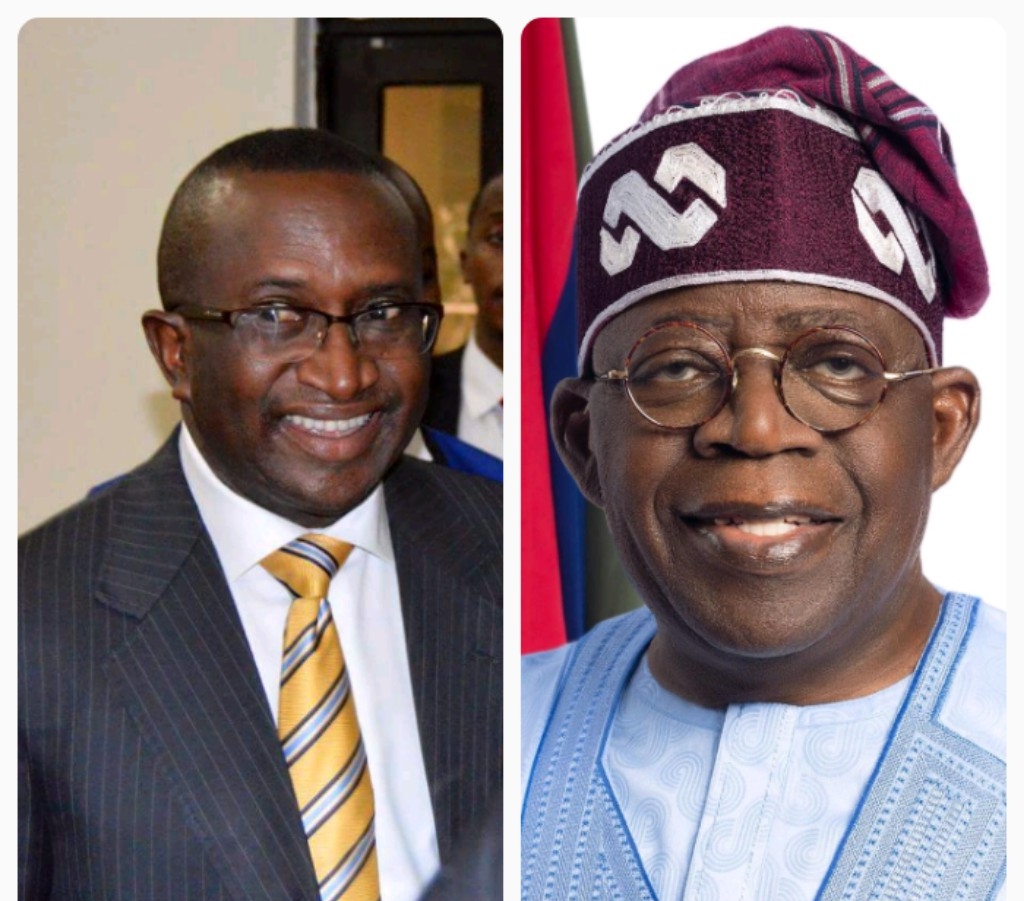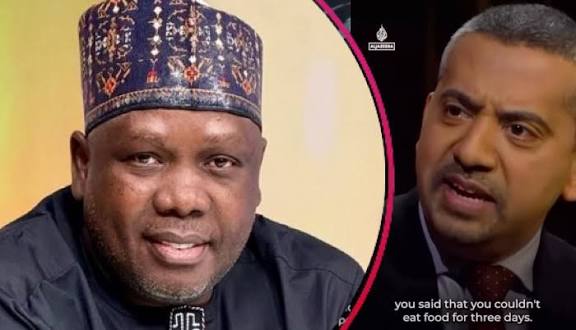
Photo: Daniel Bwala and Hasan of Al Jazeera
By: Daniel Kanu
Editor
By any reasonable standard, a spokesperson for a sitting president carries the burden of credibility.
It is therefore expected that when such an official appears on a global platform, the task will simply be to demonstrate clarity, consistency, and the presentation of facts.
Unfortunately, Daniel Bwala’s recent appearance on Al Jazeera with interviewer Mehdi Hasan exposed the opposite — a troubling display that many Nigerians viewed as evasive, comic relief, contradictory, and deeply embarrassing.
Bwala did not merely struggle to defend the Tinubu administration he now represents.
More troubling was his shameless denial of his earlier commentaries about Tinubu.
The apparent contradiction between his present defense of President Tinubu and his own past public statements evokes pity for Bwala.
Recall that before joining the Tinubu lucrative camp, Bwala was a vocal critic of the president. In numerous television interviews and public commentaries, he made strong allegations about Tinubu’s crude political arithmetic, including claims about corruption, election manipulation, vote buying and the creation and use of political militias against opponents and, by extension, the opposition.
Bwala’s statements were widely circulated in Nigerian media and on social platforms.
Yet when confronted with similar issues during the Al Jazeera interview, he cowardly distanced himself from those earlier remarks. Instead of addressing them directly or explaining a change of position, he denied and downplayed what many Nigerians remember him saying.
For a political spokesperson, such inconsistency is damaging. It feeds and confirms the perception that loyalty in Nigerian politics is often transactional rather than principled.
In everyday Nigerian language, critics describe such behaviour as “where belle face” — a situation where allegiance follows whoever pays the bill.
Whether fair or not, that label is increasingly attached to Bwala’s public image.
The interview also raised another critical concern: the apparent inability to clearly articulate the Tinubu administration’s strategy for tackling Nigeria’s pressing challenges.
Nigeria today faces two defining crises — insecurity and economic hardship.
Across many regions of the country, terrorism, violent attacks, banditry, and kidnappings remain persistent.
Communities continue to demand stronger security responses and clearer government strategies. Yet during the interview, Bwala struggled to present concrete policy measures or data demonstrating significant progress.
On the economic front, the situation is equally painful for many Nigerians.
Inflation has eroded purchasing power, food prices remain high, and millions of households are grappling with rising costs of living, with the majority not knowing where their next meal will come from.
Businesses continue to complain of declining consumer demand, while unemployment and underemployment continue to haunt the youth population.
In such circumstances, Nigerians expect government representatives to communicate clearly: What exactly is being done? What results have been achieved? What timeline should citizens expect for improvement?
Instead, the Al Jazeera appearance became a debate about credibility rather than policy.
This is unfortunate because Nigeria’s image on the global stage matters.
International audiences watching the interview were not simply evaluating Daniel Bwala; they were forming impressions about Nigeria’s political communication and mockery of governance.
When a spokesperson appears unable to reconcile past statements with present positions, the conversation shifts away from national issues and toward personal integrity.
Public trust in government communication is already fragile. Episodes like this only deepen the skepticism.
The broader lesson goes beyond Bwala himself. Nigerian politics has long suffered from a culture where politicians move easily between fierce criticism and enthusiastic loyalty depending on political opportunity. What is rarely offered is a transparent explanation for such shifts.
If Bwala truly changed his views about Tinubu, he could have said so openly, explaining what convinced him, what evidence changed his mind, and why Nigerians should believe his new position.
That would have been a far more credible approach.
Instead, the interview reinforced the growing perception that political messaging in Nigeria often prioritizes loyalty and stomach infrastructure over truth and convenience over consistency.
For many Nigerians, credibility matters more than rhetoric. Once it is lost, every future statement becomes suspect.
In the end, Daniel Bwala’s Al Jazeera appearance may be remembered less for what he said and more for what it revealed: a deeper crisis of trust in political communication due to bad governance.
Until that crisis is addressed, many Nigerians will continue to treat such voices not as reliable sources of information but simply as political actors speaking for whoever currently holds power.
The truth is that it has become increasingly difficult to defend the Tinubu-led government because available data suggests that Nigeria is sliding into deeper hardship and needs urgent rescue, as the present leadership appears to rely more on propaganda than practical solutions.