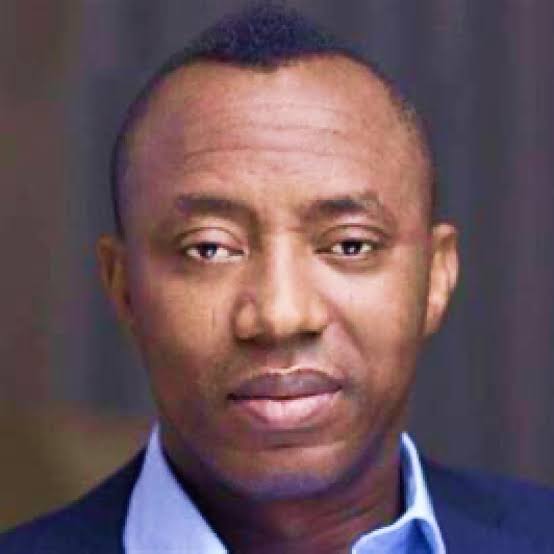
Photo: Omoyele Sowore
By: Daniel Kanu
“If Sowore is to remain relevant in this evolving political landscape, he must move beyond the politics of perpetual criticism and embrace the realities of collective action”
Omoyele Sowore is beggining to suffer from the burden of contradiction as his activism collides with political reality.
In today Nigeria’s turbulent political landscape, few figures have generated as much controversy, admiration, and frustration as Omoyele Sowore. Once widely celebrated as a fearless activist and the convener of the #RevolutionNow movement, Sowore was believed to have built his reputation on speaking truth to power, challenging entrenched authority, and mobilising young Nigerians against systemic injustice.
However, as his political journey has evolved, so too has public perception—shifting from admiration to skepticism, and in most quarters, outright distrust.
Today, Sowore stands at a crossroads, caught in what appears to be a web of contradictions that increasingly undermine both his credibility and his political relevance.
His rhetoric, actions, and positioning raise an important question: is Sowore still the perceived principled activist Nigerians once admired, or has he become entangled in a brand of politics that is now more self-serving than transformative?
At the heart of the growing criticism against Sowore is a glaring contradiction—his claim to be a leading voice of opposition while simultaneously directing much of his energy toward attacking fellow opposition figures.
In a political climate dominated by the ruling establishment under President Bola Ahmed Tinubu, one would expect opposition actors to consolidate efforts, build alliances, and present a united front.
Instead, Sowore appears to have adopted a different approach. His persistent criticism of Mr. Peter Obi—widely regarded as the most credible influential opposition figure in contemporary Nigeria and few others—has continued to raise eyebrows.
Obi, whose political movement, The Obidients, enjoys significant grassroots support and what many describe as an “organic following,” represents, to majority of Nigerians, a credible alternative to the current administration.
Yet rather than acknowledge or strategically engage with this reality, Sowore often takes a combative stance, dismissing Obi and his supporters in terms that many consider excessive. This posture has led critical minds to question whether Sowore truly seeks to strengthen the opposition or inadvertently weaken it.
Opposition politics, by its very nature, requires compromise, coalition-building, and strategic alignment. No single individual, regardless of conviction or charisma, can unilaterally dismantle a deeply entrenched political structure.
By isolating himself and alienating potential allies, Sowore risks rendering his movement ineffective.
His “Only Honest Man” Syndrome is worrisome.
A dangerous recurring theme in Sowore’s political engagement is his tendency to position himself as the sole custodian of integrity in Nigerian politics.
While his anti-corruption stance may appear commendable, the implication that every other political actor is inherently compromised raises serious concerns.
Politics is not a moral vacuum where one individual stands as the lone saint among sinners. It is a complex ecosystem that demands collaboration, negotiation, and, at times, difficult compromises.
By portraying himself as the only credible voice, Sowore inadvertently diminishes the contributions of others who are also striving—within their own limitations—to effect change.
This his “only honest man” narrative may resonate with a segment of the population frustrated with systemic corruption, but it ultimately risks alienating potential partners.
Governance, especially in a country as diverse as Nigeria, cannot thrive on ideological absolutism.
Equally troubling is his leadership without structure. There is the perception that Sowore exercises disproportionate control over his political platform.
As leader, chairman, and perennial presidential candidate of his party, he embodies a concentration of authority that contradicts the democratic ideals he frequently espouses.
A political party is not merely a vehicle for individual ambition; it is an institution that should nurture leadership, encourage internal democracy, and provide a platform for diverse voices.
When power is overly centralised, it stifles innovation and discourages participation.
For a man who has consistently criticised the authoritarian tendencies of Nigeria’s political elite, Sowore’s own leadership style invites scrutiny. Can a movement truly champion democracy while lacking internal democratic practices?
Sowore’s political communication is often characterised by perpetual, relentless criticism—not just of the ruling government, but of virtually every political actor.
While critique is an essential component of democratic discourse, it must be balanced with constructive engagement.
Take, for instance, his commentary on Dr. Alex Otti. The Abia State governor has received commendation from various quarters including the international community for efforts to reform governance and improve infrastructure. Yet Sowore’s response has largely been dismissive, focusing on perceived shortcomings rather than acknowledging progress given the time Otti took control of the clutches of power in Abia state.
Such an approach raises an important question: is the goal to hold leaders accountable or to discredit them entirely including those raising the leadership bar? The difference is significant.
In a country where public trust in leadership is already fragile, opposition figures have a responsibility to strike a balance between criticism and encouragement.
By failing to do so, Sowore risks reinforcing the very disillusionment he claims to fight against.
The truth is that Nigeria’s political history demonstrates that meaningful change often emerges from coalitions rather than solitary efforts.
From the alliances that shaped the Fourth Republic to more recent political realignments, collaboration has been key to electoral success.
Yet Sowore has consistently rejected the idea of coalition-building, preferring instead a purist approach rooted in his revolutionary ideology. While ideological clarity is important, political rigidity can be counterproductive.
The reality is that Nigeria’s complex socio-political fabric requires inclusivity. Ethnic, religious, and regional considerations make it imperative for leaders to build broad-based alliances. A monopolistic approach to politics—where one individual or ideology dominates—cannot effectively address the nation’s diverse needs.
Perhaps the most troubling aspect of Sowore’s current trajectory is the growing suspicion surrounding his political intentions.
Among most Nigerians, there is a perception—fair or not—that his actions are serving the interests of the ruling establishment.
These suspicions are fueled by his relentless attacks on opposition figures and his refusal to align with broader movements seeking change.
Others point to his international connections and funding sources, particularly his ownership of Sahara Reporters, as grounds for speculation.
Although it is important to approach such claims with caution but evidence on the ground seems to be overwhelming.
Allegations of being a “mole” or foreign agent may not have been proven beyond reasonable doubt in court, however, in politics, perception often carries as much weight as reality.
When actions consistently contradict stated goals, questions are bound to arise.
Sowore’s transition from activism to politics highlights a broader challenge faced by many public figures: the difference between protest and governance. Activism thrives on confrontation, moral clarity, and uncompromising positions. Governance, on the other hand, requires pragmatism, patience, and the ability to navigate competing interests.
Sowore’s political style still bears the hallmarks of activism—bold, confrontational, and uncompromising but something is missing.
While these traits can inspire, they can also hinder effective leadership. Governing Nigeria is not a protest; it is a complex exercise in consensus-building.
Moreover, Sowore has yet to be tested in an elective office. This lack of executive experience raises legitimate questions about his capacity to translate rhetoric into policy. Vision is important, but so is the ability to implement.
At this critical juncture, Sowore owes Nigerians clarity. What exactly is his political strategy? Who are his allies?
What practical steps does he propose to achieve the revolution he envisions?
More importantly, is he willing to work with others who share his desire for change, even if they do not meet his standards of ideological purity?
Nigeria’s challenges—economic instability, insecurity, governance deficits—are too significant for any one individual to tackle alone. They require collective effort, mutual respect, and a willingness to find common ground.
Omoyele Sowore, no doubt, remains an important voice in Nigeria’s political discourse. His courage, consistency, and willingness to challenge authority cannot be dismissed. However, his current trajectory raises serious concerns about his effectiveness as a political leader.
By positioning himself against both the ruling establishment and the opposition, Sowore risks isolating himself in a political no-man’s land—too critical to collaborate, yet too marginal to influence outcomes.
Nigeria does not need a solitary hero; it needs a coalition of committed leaders willing to work together for the common good.
If Sowore is to remain relevant in this evolving landscape, he must move beyond the politics of perpetual criticism and embrace the realities of collective action.
Otherwise, he may find that in striving to be the only voice of truth, he has inadvertently silenced his own impact.