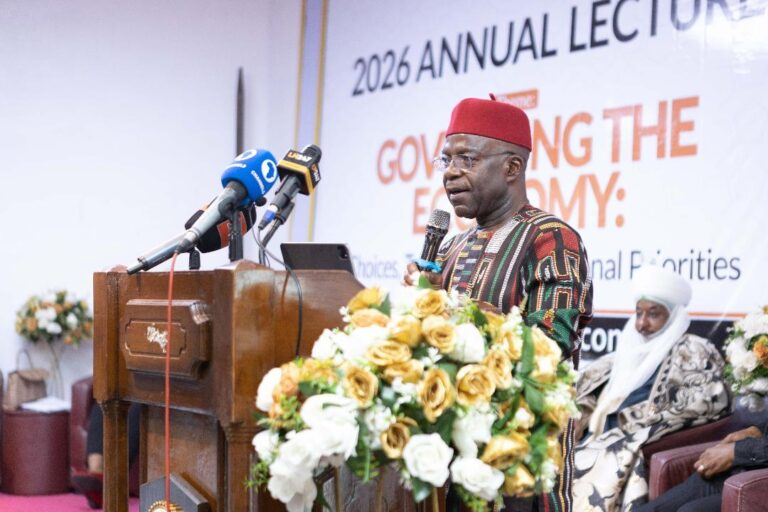
Photo: Governor Alex Otti delivering TheNiche lecture
By: Mandy Park
Abia State Governor Alex Chioma Otti has delivered a sweeping critique of Nigeria’s political economy, warning that poor leadership choices, corruption, and voter apathy remain the biggest obstacles to economic progress.
Speaking at the 2026 edition of TheNiche Annual Lecture held at the Nigerian Institute of International Affairs, Otti declared that Nigeria’s economic fortunes are inseparable from its political decisions, stressing that the 2027 general elections will determine whether the country moves toward prosperity or deeper decline.
Delivering a lecture titled “Governing the Economy: Choices, Trade-offs and National Priorities,” Otti said there is no quick fix to Nigeria’s economic challenges, describing them as “foundational” and rooted in decades of poor governance.
He argued that “incompetent political leadership” directly fuels economic decline, including shrinking GDP, rising unemployment, weak investment inflows, and widespread poverty.
“It is impossible to separate incompetent political leadership from the manifestations of economic decline,” Otti said, warning that populism, opportunism and corruption have historically “ruined several economies around the world.”
In one of the strongest highlights of his address, Otti framed the next electoral cycle as a defining moment for Nigeria’s future.
He said: “Poverty and prosperity, employment and joblessness, security and anxiety… will all be on the ballot in 2027.”
According to him, voters must understand that election outcomes send powerful signals to investors, both local and foreign, about where to commit resources.
“Investments are not attracted by media promotions or foreign trips, but by the signals we transmit through our electoral choices,” he added.
The governor strongly criticised Nigeria’s entrenched culture of vote-buying and transactional politics, likening election seasons to marketplaces.
“If we treat elections as bazaars… those who win will focus on recovering their investments rather than serving the people,” he said.
He warned that such practices undermine governance, weaken institutions, and perpetuate cycles of poverty and underdevelopment.
Otti also linked declining voter turnout—from 57 percent in 2011 to below 30 percent in 2023—to worsening governance outcomes, urging citizens to take political participation more seriously.
Rejecting simplistic solutions, the governor said Nigeria must embrace difficult but necessary reforms.
“There is no silver bullet,” he said. “We must make tough decisions and resist the temptation of quick fixes.”
He emphasised that economic governance requires discipline, long-term planning, and a willingness to make trade-offs—particularly in public spending.
Otti questioned the sustainability of welfare-heavy policies such as cash transfers and food distribution, arguing that investments in productive sectors like agriculture, power, and infrastructure would yield more durable economic benefits.
Highlighting developments in Abia State, Otti said improvements in governance, transparency, and service delivery have begun attracting businesses back to cities like Aba.
He attributed the progress to a shift in leadership behaviour, anti-corruption measures, and institutional reforms, including:, elimination of ghost workers through technology, expansion of internally generated revenue by over 300 percent investment in power through partnerships such as Geometric Power
Increased budgetary allocation to health and education.
He said these steps have restored investor confidence and improved public trust.
Otti stressed that sustainable development depends on strong institutions rather than personalities, warning against the abandonment of projects by successive administrations.
He called for: policy consistency across governments, transparent project funding frameworks, reduced waste and leakages in public finance, greater investment in infrastructure, especially power and transport.
Governor Otti also urged political leaders to demonstrate sacrifice by cutting excessive spending on luxury items and governance perks.
The governor identified insecurity, poor power supply, and weak transport infrastructure as major barriers to economic growth.
He advocated: Decentralised policing, including state police
Liberalisation of the power sector to allow state participation
Long-term investments in rail and road networks.
“Insecurity stifles growth, steals talent and keeps productive assets dormant,” he said.
Otti concluded with a call for active citizenship, urging Nigerians to go beyond voting and hold leaders accountable.
“Political indifference is costly,” he said. “Our economic destiny is tied to the choices we make and the leaders we elect.”
He challenged Nigerians—especially young professionals—to take greater interest in governance, insisting that national transformation requires collective responsibility.
The lecture, attended by prominent figures including Emir of Kano, Muhammadu Sanusi II, Obi of Onitsha, Nnaemeka Achebe, Olisa Agbakoba SAN, Prof Anthony Killa, Comrade Joe Ajaero NLC President, Elder Umah Eleazu, former military governors Ike Nwachukwu Rtd and Allison Madueke, Dame Comfort Obi, Prof Anya.O. Anya among others forms part of ongoing national conversations on economic reform and democratic accountability ahead of the 2027 elections.