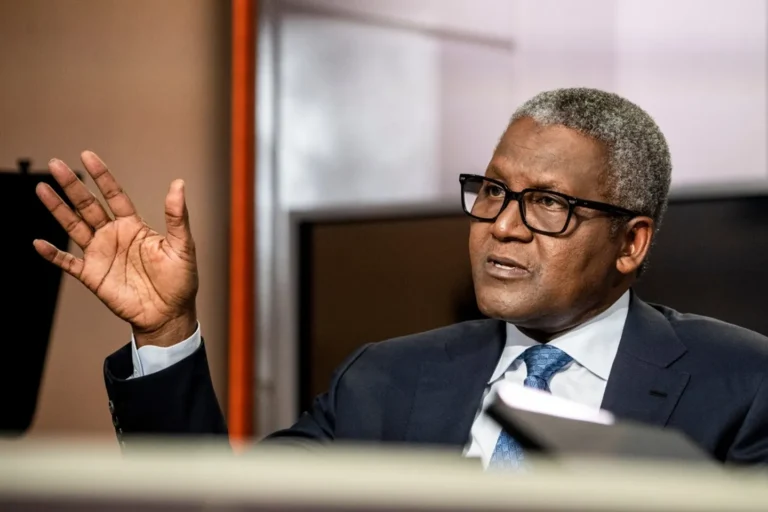
Photo : Aliko Dangote
By Mandy Park
Africa’s richest man and Chairman of Dangote Group, Aliko Dangote, has said the absence of a biological son does not bother him, stressing that his three daughters are capable of taking over the leadership of his business empire.
Dangote, who is one of Africa’s most prominent industrialists, said he would rather focus on building a strong corporate governance and succession structure than allow cultural expectations about having a male heir to dictate the future of his businesses.
The billionaire businessman stated this in an interview with ARISE NEWS Television, portions of which aired on Tuesday.
Dangote, who has three beautiful daughters — Halima, Fatima and Mariya — said he had closely observed their interests and capabilities and believed that at least one of them could successfully lead the conglomerate in the future.
He said his daughters were not being forced to join the family business but had demonstrated genuine interest in the operations of the group.
“I think, yes, I can see one of them. I’ve been watching all of them, so I can definitely see one of the three that can actually lead.
They are very, very interested in the business.
“I’m not forcing them to come and be part of this business, no. They are very interested, and they enjoy it.”
According to Dangote, his daughters’ education and exposure could enable them to introduce new ideas and take the company beyond what he had achieved.
“One of them can be better than — I never expected to perform this much. But I’m sure they’re highly educated, so they will be more creative. So most likely, they might be even taking the company to the next level,” he said.
Addressing the question of whether he wished he had a son who could inherit the family’s business empire, particularly against the backdrop of traditional expectations in Kano, Dangote said he was not worried about it.
He acknowledged that having a male child could be culturally desirable but said biological sex should not determine who was capable of carrying on the family legacy.
“Sometimes you can pray for God to give you a son, but that son might be the one to bring down the name of the family,” he said.
The businessman added that people should learn to accept what God gives them rather than force circumstances simply to satisfy societal expectations.
“Sometimes when God doesn’t give you something, don’t push. I don’t think a son would have done something better than these three daughters that I have. That one, I think, you know, it’s not my priority,” he stated.
Dangote further said that even if he had a son, he did not believe that the male child would necessarily have performed better than his daughters.
“Even if I had a son, I don’t think the son would have done better than these three daughters that I have,” he said.
The industrialist also revealed that his succession plans go beyond simply handing over the Dangote Group to one of his children.
He said his priority was to establish a professional management structure and the highest standards of corporate governance capable of protecting the conglomerate from being undermined by individual family members.
Dangote said he wanted the company to have systems strong enough to survive beyond his personal leadership.
“I want this company to be run professionally. I want to have the highest level of governance,” he said.
“We want to make sure that we make it very difficult for any family member to come and destroy anything.”
He said his ultimate legacy was not merely the accumulation of wealth but the industrialisation of Africa.
“What I want to leave as a legacy is to industrialise Africa. I cannot do it alone, but I’m 100 per cent sure that in the next two or three years, other Africans will join,” Dangote said.
Dangote’s comments come amid growing attention globally to succession planning among family-owned conglomerates, particularly businesses built around the influence and personal leadership of their founders.
The Dangote Group has expanded from its origins as a trading business into one of Africa’s largest conglomerates, with interests spanning cement, fertiliser, food processing, infrastructure and energy.
One of its most significant recent investments is the Dangote Petroleum Refinery, located in the Lekki Free Zone in Lagos.
The refinery, with a nameplate capacity of 650,000 barrels per day, represents a major component of Dangote’s long-term industrial ambitions and Nigeria’s effort to increase domestic refining capacity.
Rather than presenting succession as a question of whether a son or daughter would inherit his wealth, Dangote’s latest comments suggest that he views the future of his business empire primarily through the lenses of competence, professionalism, governance and institutional continuity.
His position also challenges the traditional assumption in some African societies that male children should automatically become successors to family wealth and businesses.
For Dangote, the central question appears to be who can preserve the institution, improve its performance and advance the larger vision he has set for the group — regardless of gender.
With his three daughters already educated and involved to varying degrees in the family enterprise, the billionaire appears confident that the next generation can build on what he has established.
His emphasis on professional management, however, suggests that the eventual leadership of the Dangote empire may not necessarily be determined by bloodline alone, but by the strength of the systems being put in place to ensure the conglomerate survives its founder.