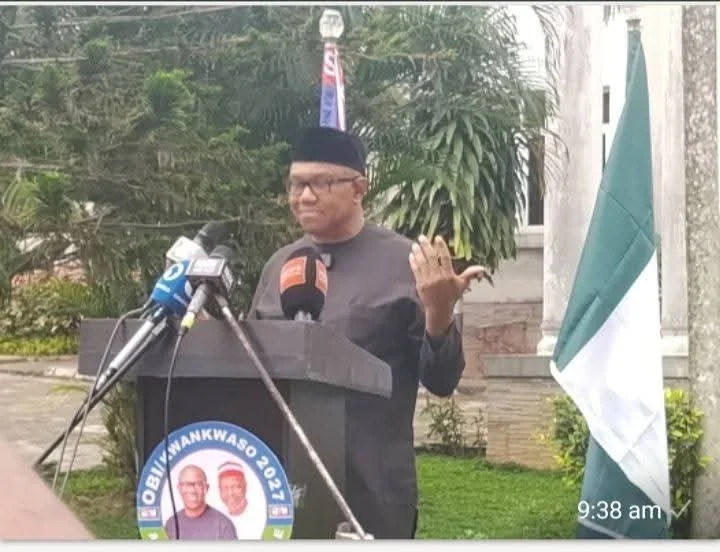
Photo: Mr Peter Obi
By Mandy Park
Presidential candidate of the Nigeria Democratic Congress (NDC), Peter Obi, has said Nigeria possesses the human and natural resources required to become a prosperous nation, but requires competent, honest and purposeful leadership to harness its enormous potential.
Obi made the assertion while participating as a guest and panellist alongside other presidential candidates and representatives at the 66th Annual General Conference of the Nigerian Bar Association (NBA) in Port Harcourt, Rivers State.
The 2026 NBA conference, themed “Beyond Limits,” was held from August 21 to 28 and brought together lawyers, policymakers, political leaders and other stakeholders for discussions on governance, democracy, the economy and the future of Nigeria.
Obi said the discussions were centred on practical ways of rebuilding Nigeria and creating a country that works for its resilient, hardworking and long-suffering citizens.
According to him, the poverty, hunger and economic hardship confronting Nigerians are not a reflection of the country’s potential, but largely the consequences of years of poor management, corruption and misplaced priorities.
“With our vast human and natural resources, Nigeria has no business being associated with extreme poverty and hunger,” Obi said.
He questioned why Nigeria, despite its vast agricultural land and favourable climatic conditions, should continue to depend heavily on food imports.
The former Anambra State governor said agriculture could become one of Nigeria’s biggest sources of wealth, employment and foreign exchange if the sector received the necessary investment, infrastructure, technology and policy support.
He particularly drew attention to the agricultural potential of Northern Nigeria, noting that its vast expanses of arable land could play a major role in transforming the nation’s economy.
“If countries with fewer resources have transformed their agricultural sectors, Nigeria can feed itself, create millions of jobs, and export food to the world,” he said.
Obi also restated his position on the removal of petrol subsidy, saying he supported its removal but believed the process should have been preceded by measures to eliminate corruption and establish the actual cost of the subsidy.
He said his preferred approach would have been to first address the corruption surrounding the subsidy regime, determine the genuine cost involved and then implement a carefully planned and phased removal.
“Mismanagement of the proceeds should not be the reason for not removing it,” Obi said during the conference.
He argued that the savings generated from subsidy removal should be transparently invested in sectors capable of improving citizens’ welfare, including agriculture, healthcare, education, infrastructure, poverty reduction and national security.
Obi subsequently reiterated that the removal of subsidy should translate into tangible benefits for Nigerians rather than worsen the hardship faced by households.
He maintained that citizens should not be subjected to higher energy and transportation costs without corresponding improvements in public services, economic opportunities and living standards.
His position places him at odds with proposals by some opposition figures, including former Vice President Atiku Abubakar, who has advocated a targeted and transparent subsidy arrangement to cushion the effect of high petrol prices on Nigerians.
Beyond the subsidy debate, Obi said Nigeria’s development priorities should focus on food security, healthcare, education, infrastructure, human capital development, security and national unity.
He stressed that the country has the resources and talent needed to overcome its challenges, insisting that the critical missing ingredient is leadership committed to the common good.
“Nigeria has all it needs to prosper. What remains is competent, honest, and purposeful leadership that puts the common good above personal interests,” Obi said.