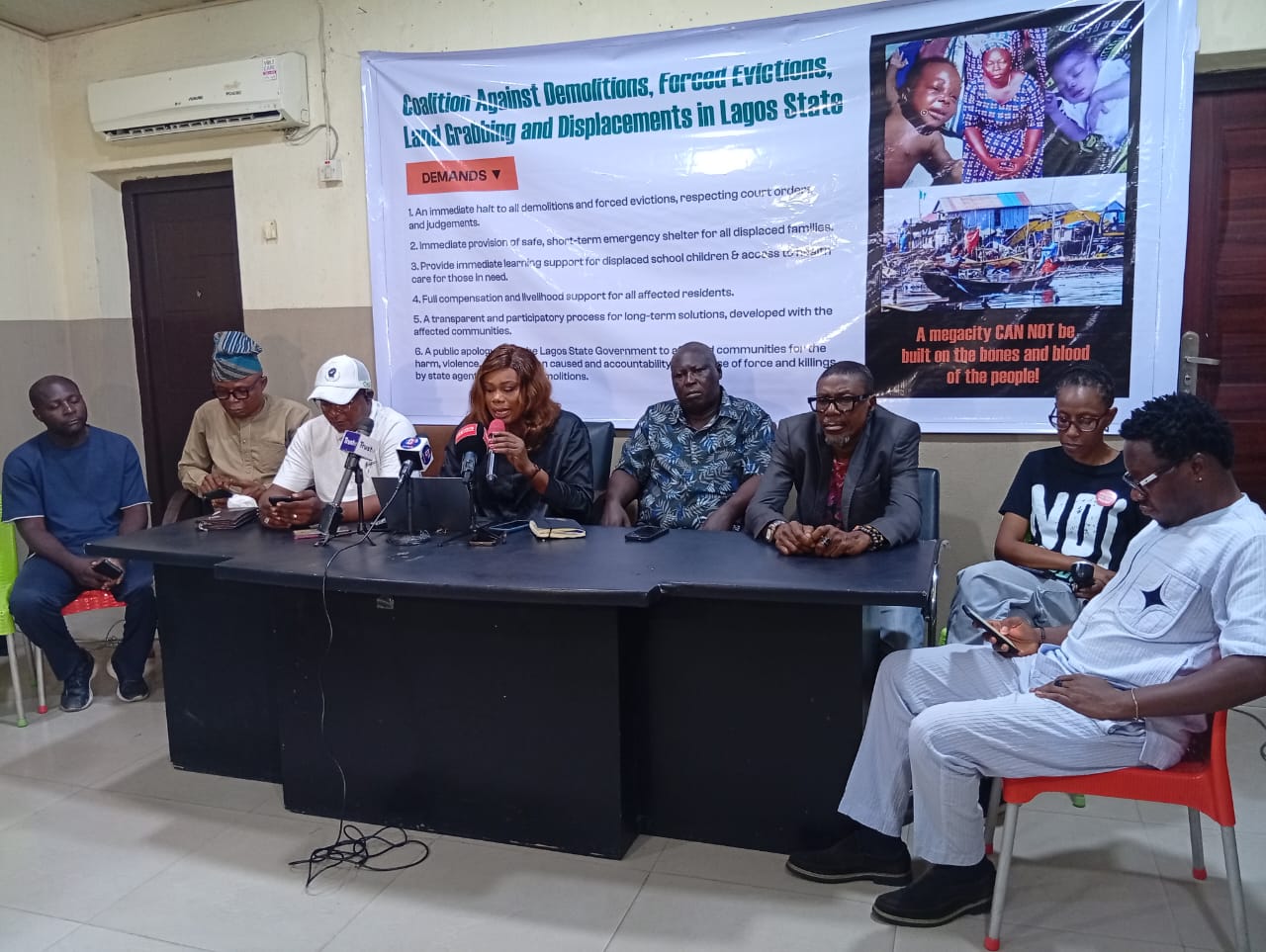
PHOTO: The Coalition groups at the world press briefing
By; Mandy Park
A coalition of national and international human rights, environmental and social justice organisations has strongly condemned what it described as systemic, illegal and cruel forced evictions being carried out by the Lagos State Government in several low-income communities, including Makoko, Oworonshoki, Owode Onirin, Otumara and Baba-Ijora.
In a joint statement made available to the media, today, Thursday 22nd January, after a world press conference at the International Press Centre in Lagos, the organisations accused the state government of orchestrating demolitions and mass displacement of thousands of residents without adequate notice, consultation, compensation or resettlement plans, alleging that the actions were aimed at clearing prime waterfront land for elite and private commercial interests.
The groups said the demolitions, often justified by the government as urban renewal or environmental safety measures, have instead resulted in what they termed “state-created homelessness,” disproportionately affecting fishermen, traders, women, children, the elderly and persons with disabilities.
According to the statement, the forced evictions have plunged affected communities into severe humanitarian distress, exposing residents to hunger, disease, loss of livelihoods, disrupted education and heightened insecurity.
In their demands,
the coalition called for an immediate halt to all demolitions and forced evictions, compliance with court orders, emergency shelter for displaced families, access to education and healthcare, full compensation for destroyed property and livelihoods, and accountability for alleged abuses and deaths.
They also demanded a transparent, community-led resettlement plan and a public apology from Governor Babajide Sanwo-Olu and the Lagos State Government.
The statement was signed by community leaders and representatives of civil society organisations, including ;
1. Israel Idowu – Student Coordinator, Makoko Waterfront community
2. Comrade Abiodun Ahmed – Chairman, Owode Motor Spare Parts Market
3. Comrade Tunde Yusuf – Secretary, Ajegunle Peoples Movement (APM)
4. Olanrewaju Olusegun – Secretary, Coalition of Oworonshoki Demolition Victims
5. Betty Abah – Founder, Centre for Children’s Health Education, Orientation and Protection (CEEHOPE).
6. Comrade Alex Omotehinse – President, Center for Human and Social Economic Rights (CHSR)
7. Zikora Ibeh – Assistant Executive Director, Corporate Accountability and Public Participation Africa (CAPPA)
8. Prince Iwamitighi R. Irowainu – President, Egbe Omo Ilaje Worldwide
9. Opeyemi Adamolekun – Active Citizen
10. Comrade Hassan Taiwo Soweto – Member, #EndbadGovernance Movement, Lagos state
The organisations noted that the demolitions were part of a long-standing pattern.
They cited the 2016–2017 evictions in Otodo Gbame, where more than 30,000 residents were displaced despite court orders, as well as demolitions in Oworonshoki in 2023, Orisunmibare in February 2024, Otto in March 2024 and Oko Baba in September 2024.
In March 2025, demolition exercises in Ilaje-Otumara and Baba Ijora reportedly left over 10,000 people homeless.
Residents were said to have been evicted without prior notice, with homes, businesses and places of worship razed by bulldozers, forcing many to sleep on the streets and disrupting food security and livelihoods.
Oworonshoki and Court Orders.
The statement also detailed events in Oworonshoki, where demolitions allegedly began in 2023 and intensified in October 2025.
The groups claimed that hundreds of homes were demolished late at night by officials of the Lagos State Government Task Force, accompanied by armed security operatives.
They further alleged that the demolitions proceeded despite an interim injunction secured on October 23, 2025, by activist and human rights lawyer Femi Falana (SAN), restraining the state government and its agencies from further demolitions in the community.
According to the groups, more than 10,000 residents were displaced, while protesters were beaten and arrested.
In Makoko, a waterfront community estimated to have over 100,000 residents, the organisations said demolitions that began on December 23, 2025, have so far affected more than 3,000 homes and displaced over 10,000 people.
They alleged that armed personnel and demolition teams repeatedly invaded the community, setting homes ablaze and deploying tear gas.
The groups claimed that not less than 12 people, including two infants, had died in the process, while schools, clinics and places of worship were destroyed.
Many displaced residents, they said, are now sheltering in boats, churches, school buildings or in the open.
The coalition also challenged the government’s claim that the demolitions were limited to buildings close to high-tension power lines, alleging that structures far beyond legally prescribed setbacks were also destroyed.
The organisations accused the Lagos State Government of neglecting its responsibility to provide basic infrastructure and social services in informal settlements, only to later cite poor living conditions as justification for demolitions.
They also accused the state of contempt of court, referencing a 2017 Lagos High Court ruling that declared forced evictions without consultation a violation of the constitutional right to dignity, as well as an August 2025 judgment of the Federal High Court, Ikoyi, which restrained further demolitions in several waterfront communities and awarded ₦3Million in damages against the state government and the Nigeria Police Force.
The damages, they noted, remain unpaid.
The groups rejected the Lagos State Government’s offer of palliatives to affected Makoko residents, insisting that victims do not need handouts but the restoration of their homes, livelihoods and social infrastructure.
They also criticised the handling of a $200 million World Bank–supported slum upgrade project, alleging that the initiative failed to meaningfully improve living conditions in Makoko and other communities, contrary to World Bank policies against displacement during slum upgrading.