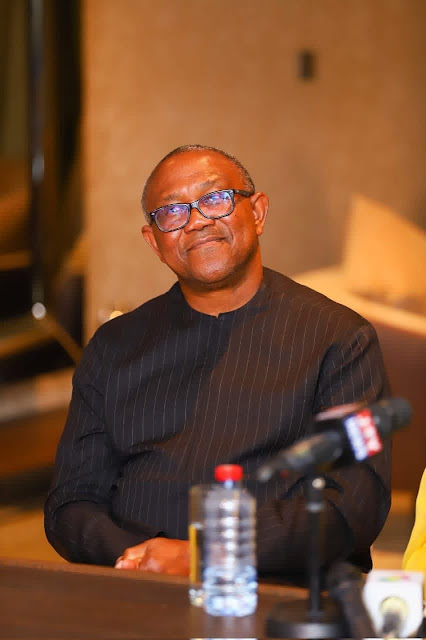
Photo: Mr Peter Obi
Nigeria’s higher education sector is facing renewed scrutiny over alleged restrictions on free expression, following claims by former presidential candidate, Peter Obi, that his scheduled lecture at Obafemi Awolowo University was abruptly cancelled.
Obi, who was the Labour Party’s flag bearer in the 2023 general elections and is a prominent aspirant of the opposition Africa Democratic Congress (ADC) for 2027, disclosed that he had been invited months earlier to deliver a keynote address at the institution on Saturday, April 25, but was informed at short notice that the event would no longer hold on campus.
In a statement shared on his X handle, Obi described the development as part of a disturbing trend, noting that it marked at least the tenth time his lectures had been cancelled by Nigerian universities.
“The invitation came months ago, and I had prepared adequately, but I received news that the event would no longer be held on campus as planned,” he said.
He cited a similar incident at his alma mater, University of Nigeria, Nsukka, where an inaugural lecture organised by the family of a former Vice-Chancellor, the late Frank Ndili, was reportedly halted by university authorities on the scheduled date.
Obi stressed that the repeated cancellations go beyond personal inconvenience, warning that they raise serious concerns about the state of intellectual freedom in the country’s academic institutions.
“These are not merely personal inconveniences; they raise deeper questions about the kind of environment we are nurturing,” he stated.
The former Anambra State governor contrasted the situation in Nigeria with his recent academic engagements abroad, where he said he had delivered lectures over the past two years at leading global institutions including University of Oxford, University of Cambridge, Harvard University, Yale University, Princeton University, University of Chicago, University of Pennsylvania, and Imperial College London.
According to him, these institutions continue to uphold openness, critical thinking, and the free exchange of ideas—values he believes Nigerian universities must protect.
“Universities are meant to be centres of learning, open dialogue, and the free exchange of ideas. When platforms for constructive engagement are repeatedly constrained, it reflects a worrying shift away from these ideals,” Obi said.
He warned that limiting intellectual discourse could have far-reaching implications for national development, stressing that progress depends on fostering knowledge, debate, and the contest of ideas.
As of the time of filing this report, authorities of Obafemi Awolowo University had not publicly responded to the allegation.
Obi, however, urged stakeholders to safeguard academic spaces, insisting that Nigeria must remain a country where ideas can thrive without fear or restriction.