By Mandy Park
The Obi-Kwankwaso Movement, popularly known as the OK Movement, has rejected the position of the National Leader of the Nigeria Democratic Congress (NDC), Senator Seriake Dickson, that political support groups must operate under the coordination of the party, insisting that it remains an independent political organisation with the right to maintain its own structures.
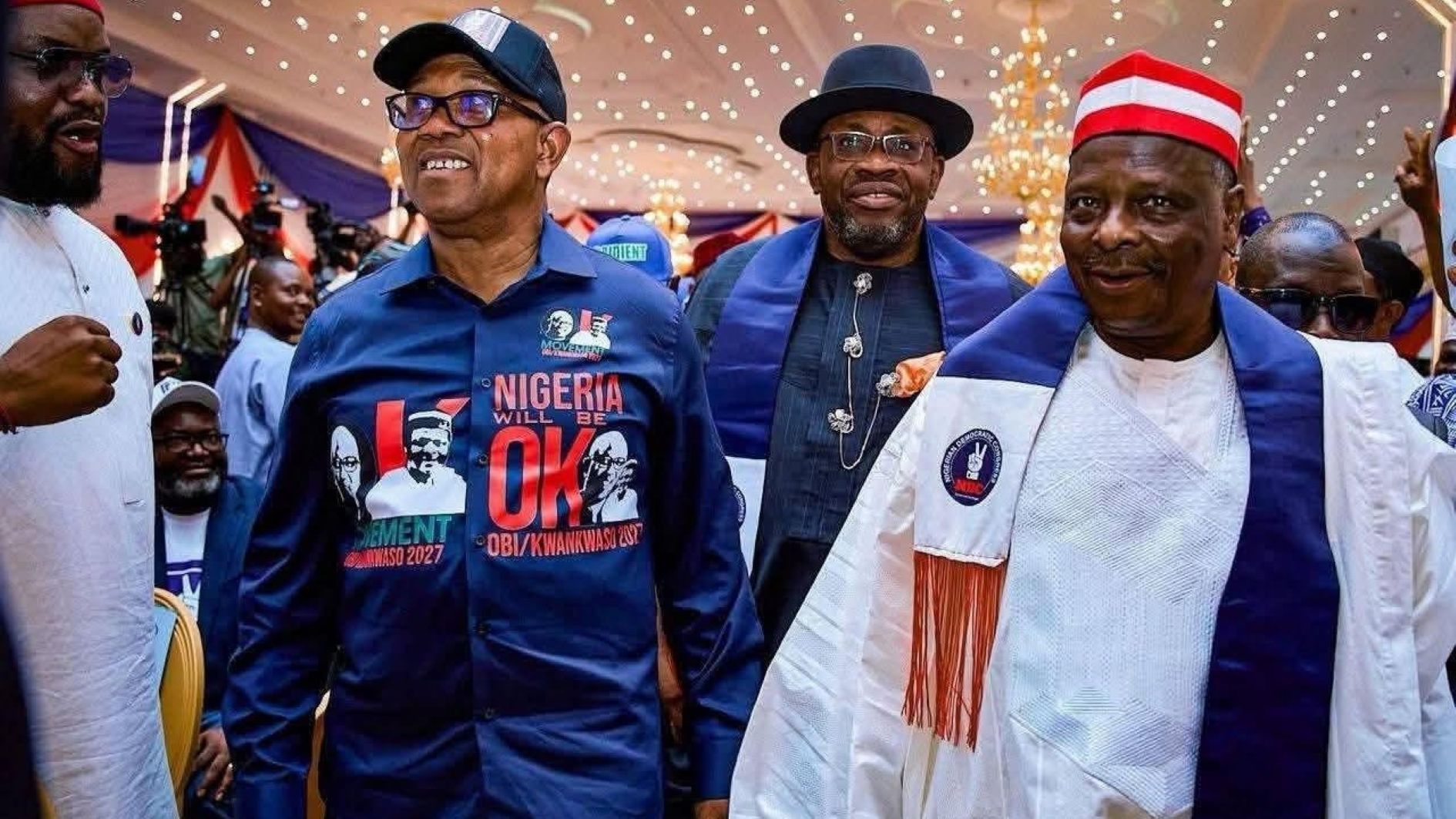
The disagreement is the latest development in an emerging dispute over the organisation of the 2027 presidential campaign of the NDC, which has Peter Obi as its presidential candidate and Rabiu Musa Kwankwaso as his running mate.
The controversy followed the unveiling by the OK Movement on September 17 of a 59-member Presidential Campaign Council comprising zonal and state coordinators as well as directors responsible for mobilisation, women affairs, strategy, security and legal affairs, among other portfolios.
The NDC subsequently dissociated itself from the council, saying the structure was not authorised by the party and should be disregarded.
The party has also been preparing its own Presidential Campaign Council, with Obi and Kwankwaso given latitude to nominate principal officers in consultation with the party leadership.
Dickson, who spoke in Abuja on Tuesday while receiving former Secretary to the Government of the Federation, Babachir Lawal, into the NDC, said support groups should complement, rather than compete with, the political party sponsoring their candidates.
According to him, support groups are expected primarily to provide grassroots mobilisation and support for candidates and should not create structures that assume the functions of the political party or its official campaign machinery.
“Support groups don’t compete with the political party that is sponsoring candidates. They don’t compete for supremacy or space. Support groups are what they are: support,” Dickson said.
He also questioned the decision of the OK Movement to establish a separate presidential campaign council, describing the move as “nonsensical” and calling on those responsible to ensure that the group operates within the appropriate framework.
But the OK Movement has rejected the position, arguing that its political collaboration with the NDC does not translate into organisational subordination.
In a statement issued by its Director-General, John Ozyl Ughulu, the movement said it was necessary to distinguish between conventional support groups and the OK Movement, which, according to him, has its own identity, structures and membership.
“If the Obidient Movement is regarded as a support movement and if the Obidient-Kwankwasiyya Movement has equally been described as a support movement, then it becomes necessary to properly define the identity and status of the Obi-Kwankwaso Movement, popularly known as the OK Movement,” Ughulu said.
“For the avoidance of doubt, the OK Movement is an independent political organisation. It is not a support group created as an appendage of any political party or another movement. It is independently organised, managed and structured through its own established movement mechanisms.”
Ughulu said the movement comprised people drawn from different political parties who shared a common political interest in the Obi-Kwankwaso ticket.
“The OK Movement comprises individuals and members from different political parties who share a common commitment to the ideals, values and political aspirations represented by the presidential candidate, His Excellency Mr Peter Obi, and vice-presidential candidate of the NDC Party, His Excellency Senator Rabiu Musa Kwankwaso,” he said.
He therefore described the relationship between the movement and the NDC as one of political collaboration rather than organisational control.
“Our cooperation with the NDC Party should therefore be understood as political collaboration, not organisational subordination,” he said.
‘We will not surrender our structures’
The OK Movement also rejected any suggestion that its structures should be placed under the control of the NDC.
Ughulu said the organisation had developed its structures through the efforts of thousands of members and coordinators across the country and would not allow them to be dissolved, transferred or absorbed into the party.
“The OK Movement remains an independent organisation. Its existence and internal administration are not subject to the internal management of the NDC Party.
“Our loyalty to our preferred candidates is unwavering. We will mobilise, campaign, vote and defend every legitimate vote cast for the candidates we support,” he said.
He added that the movement would not be merged with the NDC or any other political organisation.
“The OK Movement will not be collapsed, merged or subsumed into the NDC Party or any other organisation.
Cooperation and political alignment do not extinguish the independent identity of the Movement.
“Our organisational structure remains the property and responsibility of the OK Movement. We will not surrender our established national, state, local government and ward structures to any political party or external support group for management,”Ughulu said.
He also stressed that the movement was not seeking financial dependence on the NDC, maintaining that its mobilisation activities would remain the responsibility of its members.
Campaign council controversy.
At the centre of the disagreement is the question of whether the OK Movement can establish a campaign council of its own while backing the NDC’s presidential ticket.
The movement said it believed it had the organisational right to establish its own campaign structure and strategy for the candidates it supports.
“The Movement has the legitimate organisational right to establish its own campaign structure and strategy. We are not aware of any provision of the NDC’s constitution that expressly prohibits an independent political organisation from establishing its own campaign council or mobilisation structure in support of the party’s candidates,”
Ughulu said.
He stressed that the movement was not claiming supremacy over the NDC or seeking to exercise the constitutional powers of the political party.
“The OK Movement does not claim supremacy over the NDC and it does not seek to usurp the constitutional powers of the party,” he said.
Rather, he said, the movement wanted recognition of its right to select and support candidates, mobilise voters, coordinate its members and volunteers, campaign for its preferred candidates and establish its own operational mechanisms.
Ughulu said the structures of the movement were built over time through the commitment of members and coordinators across the country.
“We did not build the OK Movement overnight. Its structures were established through the commitment, sacrifice and participation of thousands of members and coordinators across the country,” he said.
“No individual can simply declare that structure dissolved, transferred or absorbed without the authority of the Movement’s legitimate organs.”
The dispute comes as the NDC moves to formalise its official campaign machinery ahead of the 2027 general elections.
The party has said consultations are at an advanced stage for the constitution and inauguration of its Presidential Campaign Council and has also commenced preparations for nationwide mobilisation of election agents.
The party said Obi and Kwankwaso had been given considerable latitude to nominate principal officers who would coordinate the presidential campaign.
The development has effectively created two distinct organisational questions: the NDC’s official campaign structure on one hand and the independent mobilisation structures of groups supporting its presidential ticket on the other.
The OK Movement maintains that the existence of an official NDC campaign council does not prevent it from organising its own members and supporters.
The NDC, however, has maintained that support groups should complement the party rather than establish parallel structures performing the functions of the official campaign organisation.
Obi, Kwankwaso ticket
The dispute is unfolding months after Obi and Kwankwaso formally joined the NDC ahead of the 2027 election.
The two politicians were formally received into the party in May after leaving their previous political platforms. The NDC subsequently affirmed the Obi-Kwankwaso ticket at its special convention.
The party has since positioned the ticket as the centrepiece of its 2027 presidential campaign.
The emergence of the OK Movement predates the formalisation of the ticket. The movement brings together supporters associated with the Obidient and Kwankwasiyya political networks, with its activities focused on building grassroots support for Obi and Kwankwaso.
Despite the disagreement with Dickson and other party officials over campaign structures, Ughulu said the OK Movement remained committed to working with the NDC and supporting the party’s presidential ticket.
“The OK Movement respects the NDC and recognises the constitutional authority of the party over its own internal affairs. Equally, the NDC and every other organisation must recognise the independent identity, structure and legitimate interests of the
OK Movement,” the statement said.
The movement said it would pursue any disagreement through lawful and democratic means and remain committed to peaceful participation in the electoral process.
“We will not be intimidated. We will not surrender our identity. We will not abandon the structures we have built.
“And above all, we will continue to participate peacefully, lawfully and decisively in the democratic process and defend every legitimate mandate entrusted to us by the Nigerian people,” Ughulu said.
The central issue is therefore not a disagreement over support for Obi and Kwankwaso, but who controls the machinery through which that support is organised—the NDC’s official campaign structure or the OK Movement’s independent network.
Recent reporting confirms that both sides are maintaining distinct positions on that question.