Photo: Dr Alex Otti, Abia State Governor
By: Daniel Kanu
The 2026 edition of TheNiche Lecture held today , Thursday, April 23, in Lagos, was an intellectual harvest that brought together top political, traditional, academic and labour leaders for a robust conversation on Nigeria’s economic direction, governance choices, and national priorities.
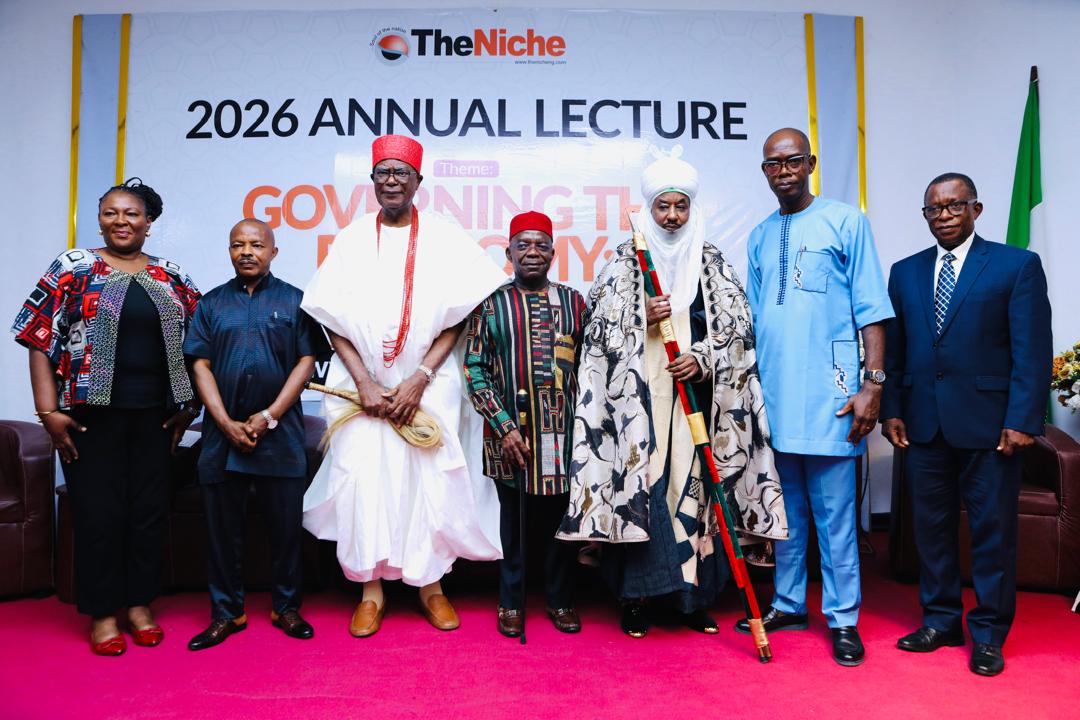
At the occasion that was well attended by the high and mighty the Abia State Governor, Alex Otti, the Emir of Kano, pointed the way forward to reposition the economy for better impact.
General Ike Nwachukwu (Rtd) Prof Anya O. Anya, Elder Umah Eleazu, Prof Anthony Killa, Dame Comfort Obi, Former military governor Allison Madueke, among other heavyweights across all sectors were present.
Governor Otti delivered the keynote address, while the revered Emir of Kano, Muhammadu Sanusi II, presided as chairman. The Obi of Onitsha, Nnaemeka Achebe, served as the royal father of the day.
Also in attendance was the President of the Nigeria Labour Congress, Comrade Joe Ajaero, alongside policymakers, economists, academics, and civil society actors.
Otti said hard choices needed to fix Nigeria’s Economy.
In his keynote, Otti underscored the urgency of making “difficult but necessary” economic decisions to reposition Nigeria for sustainable growth.
Speaking on the essence of governance and economic management, he argued that the country’s long-standing structural challenges require disciplined leadership, fiscal prudence, and a clear alignment of national priorities.
The governor highlighted the need to move away from consumption-driven policies to production-oriented strategies, stressing that subnational governments must play a more active role in economic transformation.
Drawing from his experience in Abia State, Otti pointed to ongoing reforms in public finance management, infrastructure renewal, and efforts to improve the ease of doing business.
He also addressed the implications of recent economic reforms, noting that while policies such as subsidy removal and currency adjustments may impose short-term hardship, they must be complemented by targeted social interventions and transparency to earn public trust.
According to him, “governing the economy is about making choices and managing trade-offs. Leadership must be honest about these trade-offs and ensure that the burden does not fall disproportionately on the most vulnerable.”
For Emir Sanusi, governance must be anchored on accountability.
In his remarks as chairman, The Royal Father delivered a characteristically frank assessment of Nigeria’s governance and economic realities. He emphasized that no amount of economic reform would succeed without accountability, institutional strength, and a commitment to long-term planning.
Sanusi warned against populist policymaking, arguing that sustainable development requires consistency and the courage to resist short-term political pressures. He reiterated the importance of investing in human capital—particularly education and healthcare—as the foundation for national prosperity.
The former central bank governor also stressed the need for transparency in public finance, urging leaders at all levels to rebuild citizens’ confidence in government through responsible management of resources.
“Economic growth without inclusion is a recipe for instability,” he said, adding that leaders must ensure reforms translate into tangible improvements in people’s lives.
The Obi of Onitsha, Nnaemeka Achebe, in his goodwill message, called for unity and collaboration among Nigeria’s diverse stakeholders, noting that traditional institutions remain critical partners in nation-building and social cohesion.
Meanwhile, NLC President Joe Ajaero’s presence underscored labour’s interest in ongoing economic reforms. Though he did not deliver a formal address, his participation highlighted the importance of engaging workers’ representatives in conversations around policy decisions that directly affect livelihoods.
TheNiche Lecture series has continued to serve as a platform for high-level discourse on Nigeria’s most pressing issues. This year’s edition reinforced the urgency of coherent economic governance, bold leadership, and inclusive policymaking.
As participants dispersed, a common theme resonated: Nigeria’s path forward will depend not just on policy choices, but on the integrity, courage, and accountability of those entrusted with implementing them.