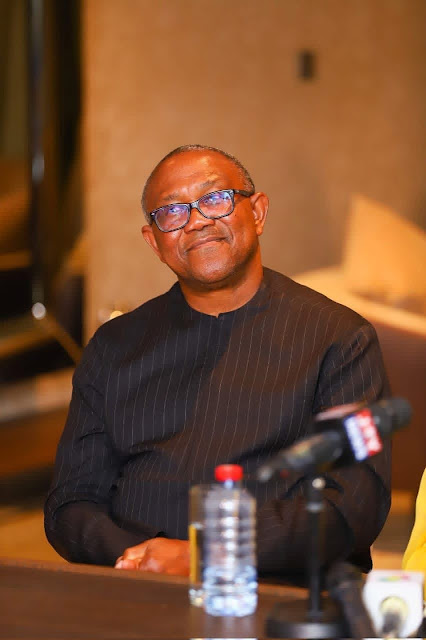
Photo: Peter Obi
By: Daniel Kanu
Since the end of the 2023 presidential election, one of the most repeated political talking points in Nigeria has been: “Peter Obi is a good man, but we cannot vote for him because Obidients are disrespectful.”
At face value, it sounds morally upright. It sounds like a principled stand against toxic political culture.
But a closer look at Nigeria’s political history reveals something else entirely — hypocrisy, selective outrage, and tribal political convenience.
Many of the people preaching “respect” today were among the loudest voices in Nigeria’s most vicious era of political insults during the administration of former President Goodluck Jonathan.
Jonathan and his wife, Patience Jonathan, suffered some of the harshest public ridicule ever directed at a Nigerian leader and First Lady.
They were mocked relentlessly in newspapers, on television, in churches, on social media and even at public rallies.
Symbolic coffins were displayed at protests and derogatory nicknames became normalized.
Every speech Jonathan made became a national joke.
Even Nobel Laureate Prof. Wole Soyinka himself notoriously referred to Patience Jonathan as “shippopotamus,” a remark that many who now preach civility either applauded or ignored.
Where were the moral lectures about “respect” then?
Where were the sermons about preserving the dignity of leadership?
Where were those who now accuse Obidients of being too vocal?
The truth is simple: what many political loyalists call “disrespect” today is often nothing more than criticism directed at a government they support.
Under Jonathan, protest was celebrated as patriotism. Today, under President Bola Ahmed Tinubu, criticism is suddenly branded as hatred, tribalism or incivility.
That contradiction exposes the deeper problem in Nigerian politics — many people do not actually believe in democratic accountability.
They only defend criticism when it benefits their side politically.
The hypocrisy becomes even more glaring when one examines the state of the country today.
Fuel prices have skyrocketed.
The naira continues to struggle against the dollar.
Electricity tariffs have increased dramatically.
Food inflation has become unbearable.
Insecurity persists across several regions.
And none of these hardships discriminate based on tribe or political affiliation.
Hunger does not ask whether one voted APC, PDP, PRP or Labour Party.
A bag of rice does not become cheaper because someone defended the government online.
Hospital bills do not reduce because one shouted “Emi Lokan.”
Economic hardship has become the great equalizer in Nigeria.
This is why the tribal manipulation that dominated the 2023 elections is gradually losing its grip.
Many Nigerians now understand that a dysfunctional country eventually punishes everyone.
Ironically, the constant attacks on Peter Obi is actually strengthening his political relevance ahead of 2027.
Despite holding no public office, Obi remains the most discussed opposition figure in Nigeria today.
Government supporters attack him daily. Presidential aides regularly reference him as unqualified to lead the country.
Even some jaded political commentators dedicate endless energy to discrediting him.
That obsession reveals a political reality many are unwilling to admit openly: Peter Obi remains the opposition candidate to beat ahead of the next presidential election.
His appeal extends beyond ethnicity because his political messaging centers largely on governance, prudence, production and accountability — issues that resonate strongly during economic hardship.
The attempt to reduce his support base to “disrespectful Obidients” is increasingly failing because Nigerians are living through realities that propaganda can no longer conceal.
Citizens are asking harder questions now.
Why is the cost of living worsening?
Why does insecurity remain pervasive?
Why are millions falling deeper into poverty despite repeated promises of renewed hope?
These are legitimate democratic questions, not acts of disrespect.
In every functioning democracy, citizens are expected to question leadership.
Accountability is not rebellion. Criticism is not treason.
What some political loyalists truly desire is not respect but silence — silence while Nigerians struggle, silence while institutions weaken, silence because “their own” is now in power.
But Nigeria has changed. The fear of speaking up is fading.
People who once tolerated poor governance because of tribal loyalty are beginning to realize that ethnicity offers no immunity from national collapse.
A failing economy punishes everyone equally. And perhaps that is the biggest lesson Nigeria is learning painfully today.
The same people who weaponized insults against Jonathan cannot suddenly become custodians of political morality because power has shifted.
Selective outrage destroys credibility.
If political criticism was acceptable under Jonathan and Buhari, it cannot suddenly become offensive under Tinubu.
Democracy does not work that way.
The truth is that Peter Obi’s growing influence ahead of 2027 is not driven merely by social media activism or emotional supporters.
It is fueled largely by widespread frustration with governance and by the perception that the political establishment is uncomfortable with an alternative political culture.
That is why attacks against him continue relentlessly.
But no amount of propaganda can permanently distract citizens from economic realities.
At the end of the day, Nigerians across every tribe, religion and region are confronting the same hardship together.
And no tribe can defend itself against a collapsing national system.