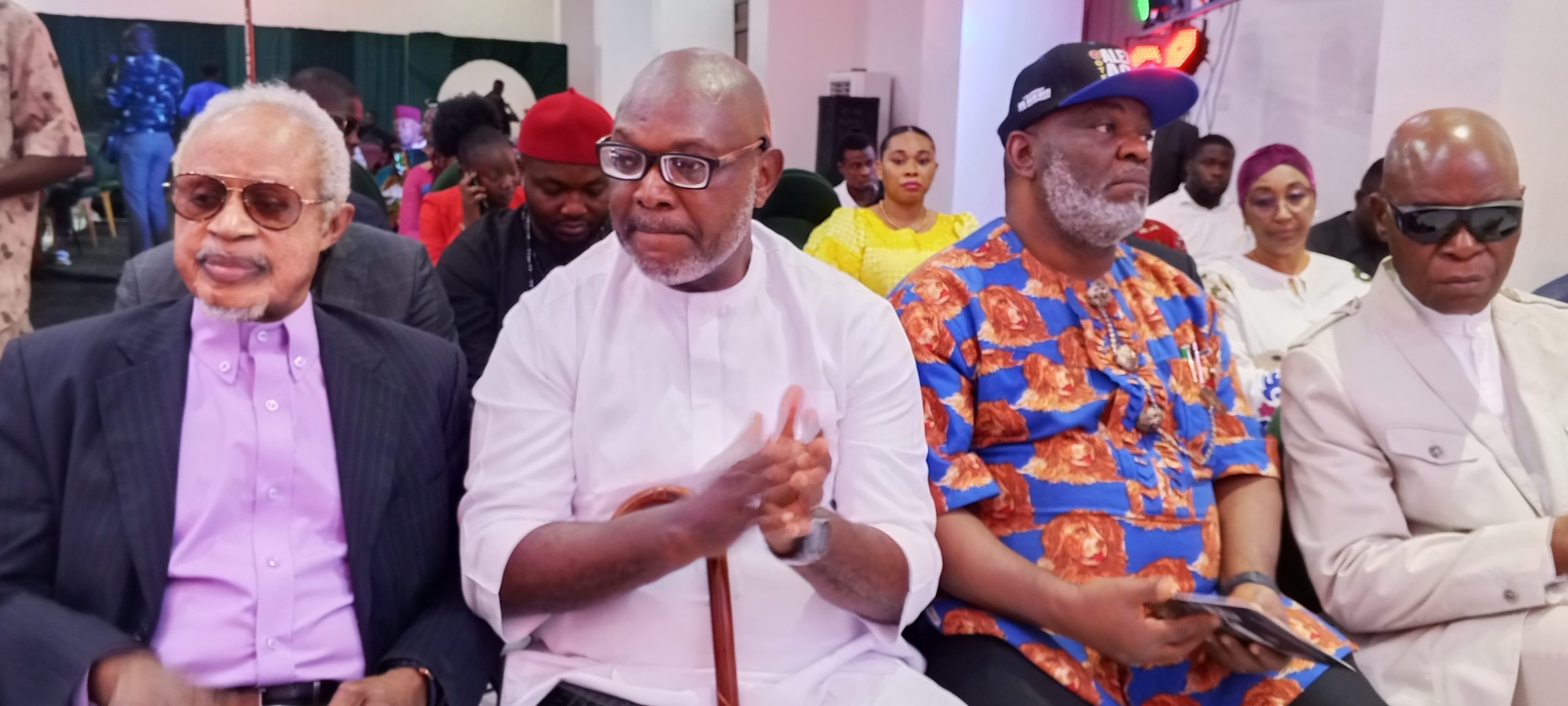
Photo: Agbeze Ireke Kalu Onuma, Clad in White, Book Author
By Daniel Kanu
“Ohanaeze must inspire the next generation” — Gov Otti
“This is not a coffee table book, it is for us to read” –Agbeze Ireke Kalu Onuma (AI-KO)
Prominent Igbo leaders, political figures and traditional rulers on Tuesday converged on Lagos for the public presentation of a new book examining the 50-year journey, challenges and future of Ohanaeze Ndigbo.
The book, Ohanaeze at 50: The Burden of Memory, The Politics of Relevance – A Critical Biographical Reflection of an Igbo Institution, written by Agbeze Ireke Kalu Onuma, was launched in the presence of Abia State Governor, Alex Otti; The Obi of Onitsha, Igwe Nnaemeka Alfred Achebe; former Anambra State governor and presidential candidate of the National Democratic Congress, NDC, Peter Obi; H.R.M Eze Kalu Kalu Ogbu IV (The Enachioken of Abiriba) Senator Enyinnaya Abaribe, Elder Dr. Uma O. Eleazu, Prof Anya O. Anya, Elder U.K. Eke, Prof Okey Anueyiagu, Mazi Sam Ohuabunwa, Dr Joe Okei-Odumakin, Elder Peter Nwankwo and other prominent Nigerians.
The gathering provided a platform for reflections on the role of Ohanaeze in preserving Igbo identity, articulating the interests of Ndigbo and navigating the complex political and socio-economic realities confronting the people.
Speaking as the Special Guest of Honour and Chief host Dr.Otti, called for a transformational shift on how Ohanaeze Ndigbo operates as it celebrates its 50th anniversary.
Otti charged Ohanaeze to take on the active responsibility of ensuring that young people keep faith with the core values, identity, and essence of what it means to be Igbo.
He called for institutional transformation, urging the organization to evolve and adapt to meet the modern realities facing Ndigbo today.
Otti commended the author, Agbeze Ireke Kalu Onuma (AI-KO), for his dedication and thorough work in documenting this critical 50-year milestone.
The Obi of Onitsha, also asked Ndigbo to do an introspection on the Igbo leadership, calling for greater unity, cohesion, and to understand the challenge, and forge a better way forward .
The revered Royal Father noted that the book holds up a vital mirror to the organization by honestly addressing internal shortcomings, and what Ndigbo should be thinking about to do.
Achebe urged the socio-cultural leadership and other Igbo political actors to embrace greater integration, think home, stressing that economic cohesion and collaboration are vital for collective regional strength.
The 602-page book is presented as neither a conventional institutional history nor a celebratory account of Ohanaeze. Rather, its author describes it as an independent intellectual examination of the organisation’s achievements, shortcomings, internal contradictions and prospects for renewal.
Onuma, who has been involved in Ohanaeze activities for several decades, said his long association with the organisation enabled him to observe its operations beyond what appeared in newspaper reports.
According to him, the book examines what Ohanaeze was, what it has become and what it could become over the next 50 years.
He argued that the organisation had achieved one of its original objectives by giving Ndigbo a voice and helping to reintegrate the people into Nigeria after the Civil War.
However, he said Ohanaeze had not fully lived up to its broader socio-cultural responsibilities, particularly in the areas of preserving the Igbo language, promoting Igbo culture and ensuring meaningful grassroots participation.
Onuma also identified elitism, internal divisions and the failure to consistently respect the organisation’s rules as some of its major challenges.
He maintained that Ohanaeze’s tendency to become involved in partisan politics had also created difficulties for an organisation whose primary identity was socio-cultural.
The author nevertheless rejected the notion that the organisation had failed completely.
He pointed to its survival through military rule, political transitions and internal crises as evidence of institutional resilience.
He also cited its role in engagements such as the Oputa Panel, cultural advocacy and efforts to maintain a pan-Igbo platform as part of its achievements.
A central argument in the book is that Ohanaeze must evolve if it is to remain relevant over the next 50 years.
Onuma advocated greater democratisation, generational transition, stronger grassroots structures, improved communication, financial sustainability and greater participation by women and young people.
He also argued that the organisation needed to strengthen its institutional memory so that its interventions would be based more on documented facts than emotion.
The author particularly challenged the exclusion of women from significant decision-making positions in some aspects of Igbo socio-cultural organisation.
He maintained that the 21st century required organisations to draw on the contributions of every segment of society capable of advancing their communities.
The book traces Ohanaeze’s origins to the post-Civil War period, when the organisation emerged as a platform for restoring an Igbo voice within a united Nigeria.
It also examines the relationship between Ohanaeze and the earlier Igbo State Union, arguing that although the two organisations served different historical circumstances, Ohanaeze succeeded the latter as a major platform for pan-Igbo conversation.
According to the author, the Igbo State Union had a stronger record of direct intervention in education, institution-building and community development, while Ohanaeze emerged primarily from the need to restore confidence and representation among Ndigbo after the devastation of the Civil War.
The book also examines successive periods of political change, leadership struggles, tensions between elders and younger generations, the rise of movements such as MASSOB and IPOB, the organisation’s relationship with Nigerian politics and its response to contemporary questions about Igbo political representation.
One of the recurring themes is the tension between the need for Ohanaeze to protect Igbo interests and the danger of allowing the organisation to become excessively partisan.
The author argued that the organisation should be able to speak firmly on issues affecting Ndigbo while maintaining sufficient institutional independence to engage governments and political actors irrespective of party affiliation.
The Lagos launch consequently became a broader conversation about the future of Igbo identity, leadership and political engagement in Nigeria.
Onuma emphasized that his work is a serious text meant for deep critical engagement rather than a mere decorative coffee-table book. He further encouraged individuals from all walks of life to take up the responsibility of documenting their own historical facts.
The presence of Governor Otti, Obi, Achebe and Abaribe and the array of personalities present at the event underscored the significance of the occasion, bringing together political leadership, traditional authority and prominent voices in contemporary Igbo affairs.
The book’s central message is that the 50th anniversary of Ohanaeze should not merely be an occasion for celebrating longevity but an opportunity for institutional introspection.
It challenges Ohanaeze to preserve the lessons of its past while reforming structures that have weakened its ability to function as an effective voice for Ndigbo.
Onuma’s conclusion is that Ohanaeze can survive another 50 years, but only if its members treat the organisation as a collective institution rather than the possession of individuals or factions.
He urged members to bring knowledge, experience and enthusiasm into the organisation while respecting its rules and institutional processes.
The author described Ohanaeze as belonging to Ndigbo collectively and not to any individual leader or faction.
The launch therefore provided both a celebration of the organisation’s golden jubilee and a critical examination of whether it can translate its historical relevance into a more effective role in the future.