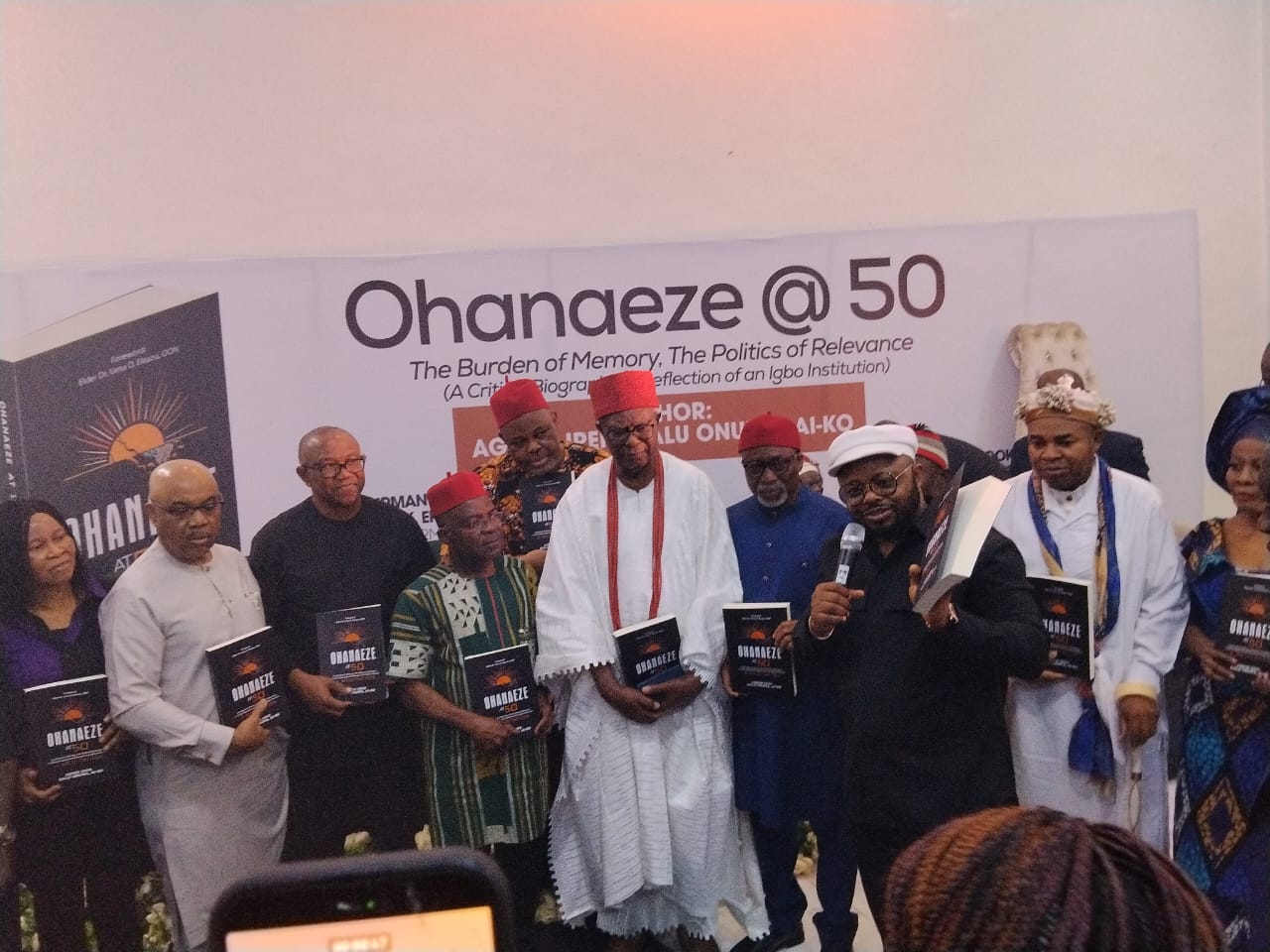
Photo: Otti, Achebe, Obi, others at the unveiling of the new book
By Daniel Kanu
The 50-year history, struggles and future of Ohanaeze Ndigbo came under intense scrutiny in Lagos on Tuesday, 22nd September, as prominent Igbo leaders, political figures and traditional rulers gathered for the public presentation of a new book examining the evolution and relevance of the apex Igbo socio-cultural organisation.
The 602-page book, Ohanaeze at 50: The Burden of Memory, The Politics of Relevance – A Critical Biographical Reflection of an Igbo Institution, written by Agbeze Ireke Kalu Onuma, provided the platform for a wide-ranging conversation on Igbo identity, leadership, unity, generational transition, political engagement and the need for institutional reform.
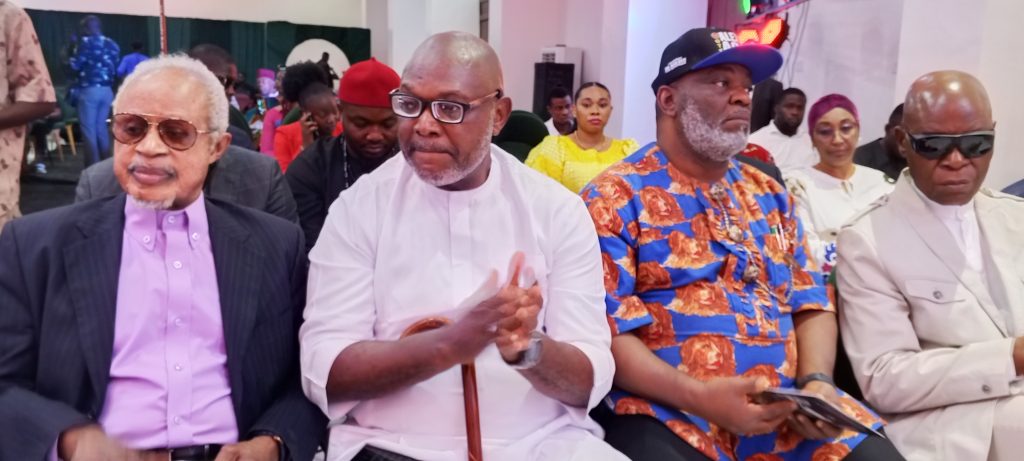
Among those who attended the event were Abia State Governor, Alex Otti; former Anambra State governor and presidential candidate of the National Democratic Congress, Peter Obi; the Obi of Onitsha, Igwe Nnaemeka Alfred Achebe; Senator Enyinnaya Abaribe; H.R.M Eze Kalu Kalu Ogbu IV (The Enachioken of Abiriba), President-General of Ohanaeze Ndigbo, John Azuta-Mbata; former First Bank Group Managing Director, Eke U. K.; Professor Okey Anueyiagu (Book reviewer); Professor Anya O. Anya; Elder Uma Eleazu; Mazi Sam Ohuabunwa, Dr Joe Okei-Odumakin, Mrs Anumudu and other prominent Igbo leaders and stakeholders.
Otti said Ohanaeze must be positioned to inspire younger generation.
Speaking as Special Guest of Honour, Governor Otti said the golden jubilee should not be viewed simply as an occasion to celebrate the organisation’s longevity but as an opportunity for serious introspection about its past, present relevance and future.
Otti said the book raised fundamental questions about institutional renewal, generational transition and the relationship between leadership and the people it claimed to represent.
“At 50, an institution deserves celebration, but it also deserves reflection,” the governor said, asking what Ohanaeze had become, what it should be and what it must do to remain relevant to generations of Ndigbo yet unborn.
According to him, the future of the Igbo people could not be secured by nostalgia alone.
He said Ohanaeze needed institutions that understood the aspirations of young people, embraced technology and innovation, engaged the global Igbo diaspora and converted cultural identity into economic, intellectual and political strength.
Otti also stressed the importance of building institutions that would survive individual personalities and political seasons.
His intervention effectively shifted the discussion from the celebration of Ohanaeze’s 50-year existence to the question of whether the organisation could reinvent itself to meet the demands of a changing generation.
The governor commended Onuma, author of the book for undertaking the task of documenting the history and challenges of the organisation, describing the anniversary as an opportunity for Ndigbo to examine what remained undone.
For Igwe Nnaemeka Achebe, Obi of Onitsha, Ohanaeze should remain above partisan politics.
The royal father was more direct in his assessment of the organisation’s relationship with politics, urging Ohanaeze to return firmly to its role as a socio-cultural institution and remain above partisan politics.
Achebe said Ohanaeze should serve as the conscience of the Igbo people rather than becoming an arena for competing political interests.
He warned that internal divisions and political factionalism had weakened the organisation’s ability to speak with one voice.
According to him, when Ohanaeze appeared before the Federal Government or other national institutions as different factions pursuing different agendas, its collective voice was weakened.
He argued that the organisation should not become politically partisan merely because individual members had political interests.
Achebe also challenged Igbo leaders to convert the people’s considerable achievements in education, entrepreneurship and global economic activity into stronger institutional capacity.
He urged those leading Ohanaeze, as well as those who would lead it in the future, to read Onuma’s book “as a mirror” and confront the weaknesses identified in it.
The traditional ruler also called for greater economic integration among Ndigbo, arguing that collective economic strength remained critical to the region’s future.
For Obi, the anniversary offered an opportunity for Ndigbo to celebrate their heritage while recognising the importance of working with other ethnic groups for the development of Nigeria.
The former Anambra State governor and NDC presidential candidate said Ndigbo should remain proud of their identity and heritage but use that identity to promote cooperation rather than isolation.
“We are proud to be Igbo, and we are proud of our heritage,” Obi said, stressing the need to use the celebration to demonstrate love and care for other cultures and ethnic groups while working collectively to develop Nigeria.
His position placed the discussion of Ohanaeze within the broader question of Nigeria’s national cohesion, suggesting that ethnic identity and national development need not be contradictory.
For Onuma, the author, the book is not a conventional anniversary publication designed merely to celebrate Ohanaeze.
It is a critical examination of the organisation from the perspective of someone who has spent decades observing its activities from within.
In a pre-launch interview, Onuma had explained that his involvement with Ohanaeze began when he returned from the former Soviet Union and became involved in Igbo organisations.
He said he started as a young man assisting his mentor, the late Justice Eze Ozobu, who served as President-General of Ohanaeze between 2000 and 2003.
That experience, he said, gave him access to the internal workings of the organisation and exposed him to the personalities, decisions, conflicts and negotiations that did not always make newspaper headlines.
Onuma said the book was therefore written from years of observation rather than as a commissioned anniversary project.
He deliberately avoided seeking official authorisation from the Ohanaeze leadership because, according to him, he wanted the work to remain independent and uninfluenced by the organisation.
“I never wrote an official letter to the Ohanaeze leadership seeking authorization because I didn’t want the project to be influenced in any way,” he said in the interview.
The book examines Ohanaeze’s history from its emergence in the post-Civil War period, when Ndigbo were seeking a new footing within Nigeria, to the organisation’s subsequent engagement with successive military and civilian administrations.
One of the book’s central arguments is that Ohanaeze’s survival for five decades is itself significant, but longevity alone cannot guarantee relevance.
Onuma traces the organisation’s emergence to the difficult period following the Nigerian Civil War and argues that its initial mission was to provide Ndigbo with a collective voice within a united Nigeria.
That historical circumstance, according to him, influenced the cautious approach adopted by the organisation in dealing with successive governments.
He described this approach through the Igbo principle of ako na uche — wisdom and understanding.
But the author argues that the circumstances that produced Ohanaeze have changed and that the organisation must therefore reconsider how it operates.
A major concern raised in the book is the tension between Ohanaeze’s declared identity as a socio-cultural organisation and its repeated involvement in partisan political affairs.
Onuma argues that the organisation needs to define more clearly the boundary between advocacy on matters affecting Ndigbo and direct participation in partisan politics.
Onuma does not present Ohanaeze as either an unqualified success or a failed institution.
Rather, the book weighs its achievements against its shortcomings.
Among the organisation’s contributions identified in the book are its survival through military dictatorship and democratic transitions, its advocacy on Igbo cultural issues, participation in national conversations, involvement in the Oputa Panel and efforts to maintain a pan-Igbo platform.
The author also examines the organisation’s role in issues such as state creation, Igbo language advocacy, World Igbo Day, diaspora engagement and the question of political representation.
But alongside those achievements, the book identifies internal factionalism, elite capture, weak institutional enforcement, generational disconnect, funding problems and the difficulty of maintaining independence from political interests.
A review of the book published by BusinessDay described it as a critical meditation that examines whether Ohanaeze remains a “living iroko” or risks becoming an institution remembered for its history rather than relied upon for its present relevance.
Onuma challenges younger Ndigbo to take ownership of the organisation rather than simply criticising its weaknesses from outside.
In his words, the younger generation has a stake in the inheritance handed down by previous generations and must step forward to reform and sustain the institution.
He also rejects the assumption that young Igbo people are completely uninterested in Ohanaeze.
Rather, he argues that young people are having conversations about the organisation in new ways and that the challenge is for Ohanaeze to create structures capable of connecting with those conversations.
The book also calls for greater participation by women and young people in the affairs of the organisation.
Onuma argues that an institution seeking relevance in the 21st century cannot afford to operate without drawing fully on the talents and experiences of women, professionals and younger Nigerians.
The author advocates a more digitally connected Ohanaeze capable of engaging young people and the growing Igbo diaspora across different parts of the world.
The book also proposes stronger engagement with the global Igbo community and the development of sustainable financial structures that would reduce the organisation’s dependence on individuals and political patrons.
A recurring criticism in the book is the gap between statements issued by Ohanaeze and measurable benefits to ordinary Ndigbo.
Onuma argues that relevance should be demonstrated not merely through communiqués and public declarations but through practical interventions in areas such as education, economic development, culture, infrastructure, legal advocacy and community development.
The book therefore advocates a transition from a largely reactive organisation to one with long-term strategic programmes.
It also calls for stronger grassroots structures so that Ohanaeze is not perceived merely as an association of prominent politicians, businessmen, traditional rulers and professionals.
At the Lagos presentation, the speakers broadly converged around the need for stronger unity, institutional renewal, generational inclusion and a clearer definition of Ohanaeze’s place in Igbo affairs and Nigerian national life.
For Onuma, however, the ultimate responsibility does not belong only to those currently occupying leadership positions.
He urged Ndigbo, particularly younger people, to join the organisation, bring their knowledge and energy into it, ask questions and participate in its reform.
“Ohanaeze is our own. No one person owns it,” he said.
Onuma’s book has no doubt, become an invitation to Ndigbo to decide what kind of institution they want Ohanaeze to become in the next half-century.