Photo: Peter Obi
By Mandy Park
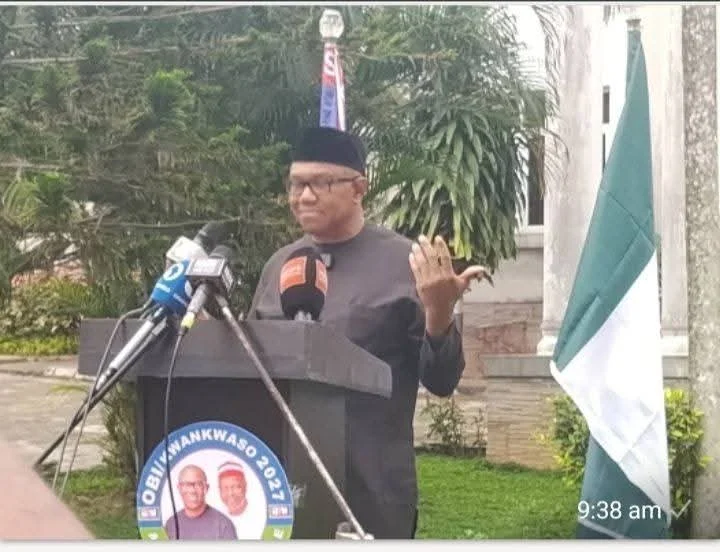
Valentine Obienyem, media aide to the former Anambra State Governor and presidential candidate of the Nigeria Democratic Congress, Peter Obi, has criticised the Minister of Works, Dave Umahi, over his recent comments about the former governor.
Obienyem accused Umahi of resorting to ethnic and geographical sentiments in his political attacks against Obi, urging the minister to focus instead on issues concerning his own political career.
He was reacting to recent remarks attributed to Umahi, in which the minister reportedly urged the people of Ebonyi State not to support politicians from outside the state and challenged Obi to identify an indigene of Ebonyi State he employed while serving as governor of Anambra.
In a statement, Obienyem described the remarks as an attempt to make ethnicity and place of origin instruments of political mobilisation.
He said, “The Obidient movement is not fundamentally about attacking people who disagree with Peter Obi. It is about confronting the systemic ills of Nigeria and seeking a better country.”
The former governor’s aide accused Umahi of engaging in what he described as “politics of emotional provocation, ethnic insinuation and calculated grievance.”
Obienyem also referred to the recent death of a young woman in Umahi’s residence, saying the minister should address questions surrounding the incident.
The former governor’s aide also questioned the economic justification for the Ebonyi airport project embarked upon during Umahi’s tenure as governor.
According to him, the airport became a subject of public debate over its utility and economic viability, which he described as part of what he termed “vanity projects” of the former governor.
Obienyem said, “Instead of concentrating on Peter Obi, Umahi should answer questions surrounding controversies associated with his own political career and governance record.”
He also rejected criticism of Obi over the renaming of Abakaliki Street in Anambra State.
Obienyem recalled that he personally opposed the decision by the administration of former Governor Willie Obiano to rename the street, arguing that Obi could not be expected to intervene in every decision taken by a successor simply because it affected people from Ebonyi State.
Defending Obi’s record as governor, Obienyem said the former governor did not administer Anambra on the basis of ethnic or geographical considerations.
He claimed that Obi deliberately avoided concentrating appointments among people from his native Agulu and noted that some senior security officials attached to the former governor were from Ebonyi State.
He also cited Obi’s interventions in Ebonyi State during the COVID-19 pandemic and his financial support for educational institutions in the state as evidence of what he described as his inclusive approach to governance.
On the 2019 presidential election, Obienyem recalled that Obi became the running mate to former Vice-President Atiku Abubakar on the platform of the Peoples Democratic Party.
He claimed that Umahi initially opposed Obi’s emergence as Atiku’s running mate before later expressing support for the ticket.
Obienyem said he personally accompanied Obi to meet Umahi in Abakaliki during the period, adding that the experience subsequently made him question the minister’s current disposition towards the former Anambra governor.
The media aide further criticised what he described as the tendency of some political leaders to use ethnicity and state of origin as a basis for determining political support.
He questioned why Nigerians should be encouraged to support or reject a candidate primarily because of the state from which the candidate comes.
Describing such an approach as “the politics of fear, grievance and exclusion,” Obienyem said Nigeria needed leaders capable of promoting national unity rather than deepening ethnic divisions.
He said, “A country of more than 200 million people cannot afford leaders who tell citizens that the accident of birthplace should determine whom they may support, employ or regard as their brother.”
Obienyem urged politicians to move beyond ethnic and geographical calculations and focus on issues capable of addressing the country’s developmental challenges.
He said Nigeria needed “inclusive, humane and nationally minded leadership,” which he maintained was the approach Obi had consistently represented.