By Mandy Park
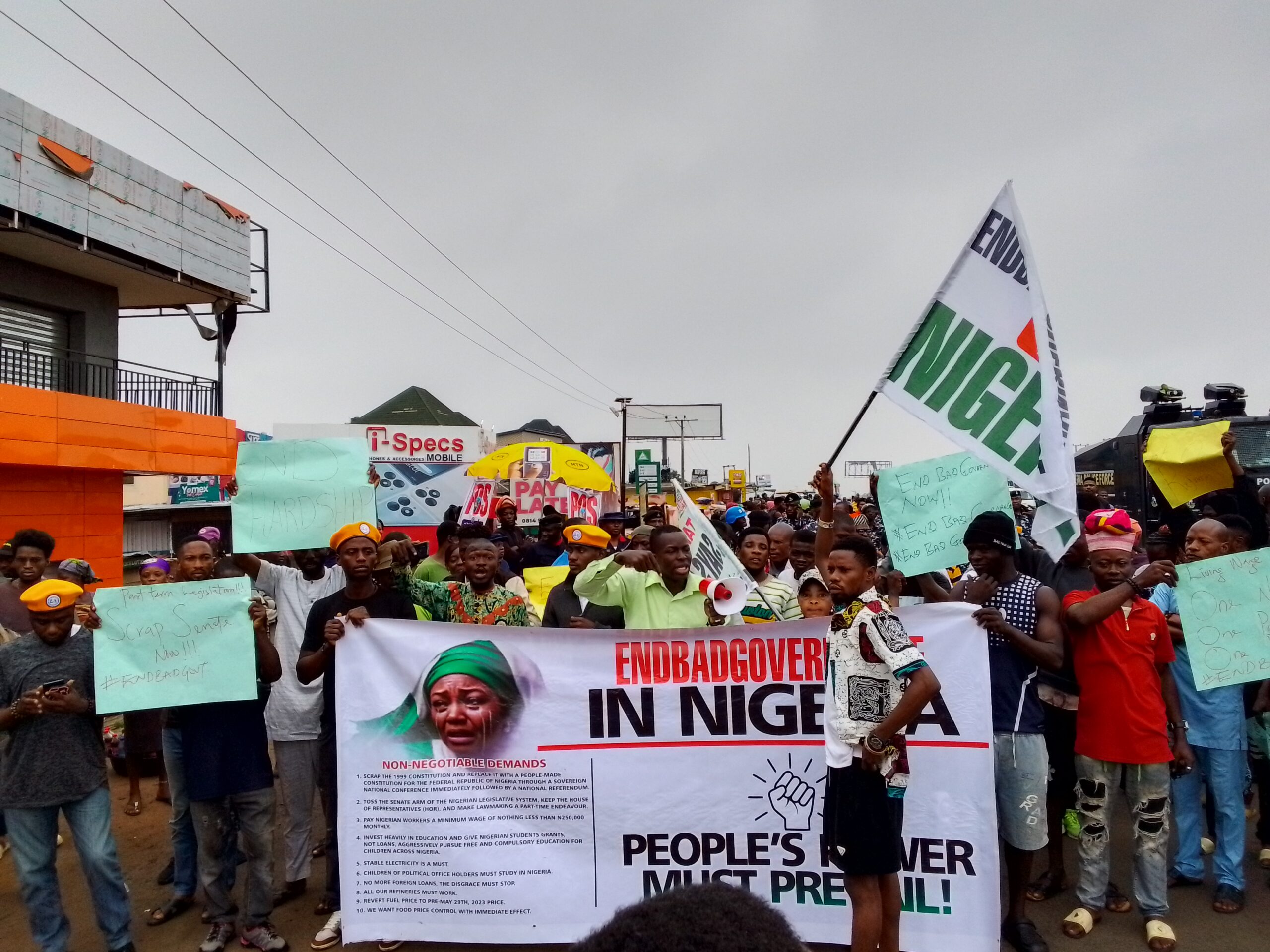
The Movement for Fundamental Change (MFC) has called for the removal of President Bola Tinubu in the 2027 general election, accusing his administration of worsening poverty, hunger, insecurity, unemployment and economic hardship in the country.
The group said Nigerians had been subjected to unprecedented suffering under the All Progressives Congress-led Federal Government, arguing that the administration had failed to fulfil its promises of economic prosperity, food security, job creation and improved living conditions.
It, therefore, urged Nigerians to use the 2027 presidential election to reject Tinubu and the APC, describing the forthcoming poll as an opportunity for citizens to deliver their verdict on the administration’s performance.
The group made its position known in a statement issued on Monday, November 9, 2026, titled, ‘The People’s Verdict: Tinubu Must Go’.
It maintained that the President’s Renewed Hope agenda, which formed the central message of his campaign in 2023, had failed to translate into meaningful improvements in the lives of ordinary Nigerians.
According to the MFC, rather than experiencing the promised prosperity, millions of citizens are battling worsening hunger, poverty, insecurity and uncertainty about their economic future.
The group said, “In 2023, Nigerians were promised Renewed Hope. They were promised prosperity, jobs, food security, safety and a better future. Today, millions of Nigerians are confronted with a very different reality: deeper hardship, renewed hunger, insecurity and uncertainty about tomorrow.
“When promises are deceitful and the people suffer, the people have a right to deliver their verdict: Tinubu must go.”
The MFC cited poverty as one of the major indicators of what it described as the failure of the Tinubu administration, claiming that Nigeria had become one of the countries with the highest number of people living in extreme poverty.
It referenced figures from the World Bank’s Poverty and Inequality Platform, which it said showed that 94.7 million Nigerians were living in extreme poverty.
The group argued that the country’s enormous human and natural resources should not be accompanied by widespread deprivation, insisting that the increasing number of Nigerians struggling to meet their basic needs reflected the consequences of poor economic management.
The World Bank’s more recent country assessment also paints a grim picture of Nigeria’s poverty challenge. It estimated that 50.8 per cent of Nigerians, representing about 123 million people, lived in extreme poverty in 2025, using its applicable poverty measurement.
The organisation further accused the Federal Government of presiding over an economy in which food prices had risen beyond the reach of many households, while the purchasing power of workers and small business owners continued to decline.
It said Nigerians were not hungry because they were unwilling to work but because the economic environment had made survival increasingly difficult.
The MFC argued that rising living costs, declining household incomes and the difficulties confronting businesses had made it increasingly difficult for citizens to afford food, healthcare, education and other necessities.
On education, the group expressed concern over the country’s growing out-of-school children crisis, claiming that the figure had risen from about 10 million to 18.2 million.
It warned that the situation could expose millions of Nigerian children to poverty, exploitation, criminal activities and hopelessness, adding that the government could not claim to be building a prosperous future while a significant number of children remained outside the classroom.
Nigeria’s out-of-school children crisis has remained a major concern for international development organisations. UNICEF and UNESCO figures have put the number at approximately 18.2 million to 18.3 million in recent assessments.
The group also condemned the security situation across the country, alleging that the government had failed in its constitutional responsibility to protect lives and property.
It listed kidnapping, attacks on communities, displacement of residents, insecurity on highways and threats to farmers as some of the challenges confronting Nigerians.
According to the MFC, the persistent attacks on farming communities had further compounded the country’s food security challenges, as many farmers were afraid to return to their farmlands for fear of being kidnapped or killed.
It also expressed concern over the conditions of internally displaced persons, saying many displaced Nigerians continued to live in difficult circumstances without adequate government support.
The organisation maintained that security should be a priority for any responsible government, arguing that citizens should not be forced to live in constant fear while travelling, farming or conducting their legitimate businesses.
On the country’s rising debt profile, the group accused the Tinubu administration of placing an enormous financial burden on present and future generations through continued borrowing.
It questioned the benefits Nigerians had derived from the government’s borrowing, arguing that the growing debt obligations had not translated into corresponding improvements in infrastructure, healthcare, education, employment and social welfare.
Figures released by the Debt Management Office showed that Nigeria’s total public debt stood at N166.79tn as of June 30, 2026, representing an increase of N7.44tn from the N159.35tn recorded at the end of March 2026.
The debt stock comprised N91.59tn in domestic debt and N75.20tn in external debt.
The MFC also raised concerns over alleged corruption and the management of public resources, insisting that government revenue should be deployed towards improving the welfare of citizens.
It specifically referred to the controversial N210tn financial discrepancies raised in connection with the accounts of the Nigerian National Petroleum Company Limited between 2017 and 2023.
The controversy attracted attention following a Senate committee’s examination of the company’s financial records, which identified N103tn in accrued expenses and N107tn in receivables requiring clarification.
The Senate committee had questioned the explanations provided by the NNPCL and called for further accountability over the figures.
The MFC said the controversy underscored the need for transparency and accountability in the management of public funds, particularly at a time when millions of Nigerians were struggling to afford basic necessities.
It added that public resources should serve the interests of citizens rather than disappear into a system of alleged financial impropriety and impunity.
The group also criticised the continued expenditure on the rehabilitation of the country’s refineries, arguing that billions of dollars had been committed to the projects without delivering the expected benefits to Nigerians.
It said the failure to achieve corresponding results from the huge expenditure represented another example of the mismanagement of national resources.
The organisation further accused the Tinubu administration of maintaining an expensive system of governance while asking ordinary Nigerians to endure economic hardship and make sacrifices.
It said the growing disparity between the living conditions of political officeholders and those of ordinary citizens had reinforced public dissatisfaction with the government.
The MFC argued that public officials should demonstrate commitment to reducing the cost of governance instead of enjoying privileges while citizens grappled with rising food prices, transportation costs, school fees and healthcare expenses.
On the state of the country’s democratic institutions, the group expressed concern over what it described as growing pressure on the legislature and the judiciary.
It said public confidence in democratic institutions had weakened, while concerns over the independence, integrity and credibility of the judiciary required urgent attention.
The organisation warned that the survival of democracy depended on the ability of critical institutions to discharge their responsibilities without political interference.
It consequently urged Nigerians to resist attempts to divide the country along ethnic, religious and political lines, arguing that poverty, hunger and insecurity affected citizens irrespective of their backgrounds or political affiliations.
According to the group, the suffering of Nigerians should be treated as a national concern rather than a partisan issue.
It said, “Hunger has no tribe. Poverty has no religion.
Insecurity does not ask whether its victims are NDC, APC, SDP, PDP or members of any other political party.
“The suffering of the Nigerian people is a national suffering, and the response must be a national democratic decision: Tinubu must go.”
The MFC stressed that the 2027 general election should go beyond political slogans, campaign promises and personality contests, describing it as an opportunity for Nigerians to assess the performance of the incumbent administration.
It urged voters to consider the state of their businesses, families, communities and the future of their children before making their choices at the ballot box.
The group also insisted that the administration should be judged by its performance rather than its campaign promises, maintaining that political speeches and government propaganda could not address the daily economic challenges confronting Nigerians.
It said, “No propaganda can reduce the price of food in the market. No political speech can put food on an empty table. No government press statement can restore a business that has collapsed under rising costs.
“Nigerians do not feed on skewed government statistics; they live with the consequences of government policies every day.”
The organisation called on Nigerians across the country’s six geopolitical zones to unite in demanding accountability, good governance, economic recovery and a government that prioritises the welfare of citizens.
It maintained that the country could not afford to continue on what it described as the path of corruption, insecurity, incompetence, poverty, lawlessness, excessive borrowing and reckless management of national resources.
The group finally declared that the 2027 election must serve as a referendum on the Tinubu administration and the direction of the country.
“We have seen enough. We have suffered enough. Nigeria cannot afford to continue down the road of corruption, insecurity, incompetence, poverty, lawlessness, unprecedented borrowing and the reckless mismanagement of national resources.
“Enough is enough. The people’s verdict is clear: Tinubu must go,” the statement added.
Tinubu, who was elected President in February 2023 and inaugurated on May 29 of the same year, is seeking to complete his first four-year term amid continuing debates over the impact of his administration’s economic reforms, including the removal of the petrol subsidy and the unification of the foreign exchange market.
The reforms, introduced shortly after his assumption of office, have attracted massive criticism, with the Federal Government maintaining that they are necessary to stabilise the economy and place the country on a sustainable growth path.
The opposition parties and other critics have continued to demand greater accountability, improved security and measures to cushion the effects of the reforms on households and businesses.
The MFC’s declaration adds to the growing political criticism of the Tinubu administration ahead of the 2027 general election, which is expected to be shaped by debates over economic performance, national security, corruption, governance and the welfare of Nigerians.