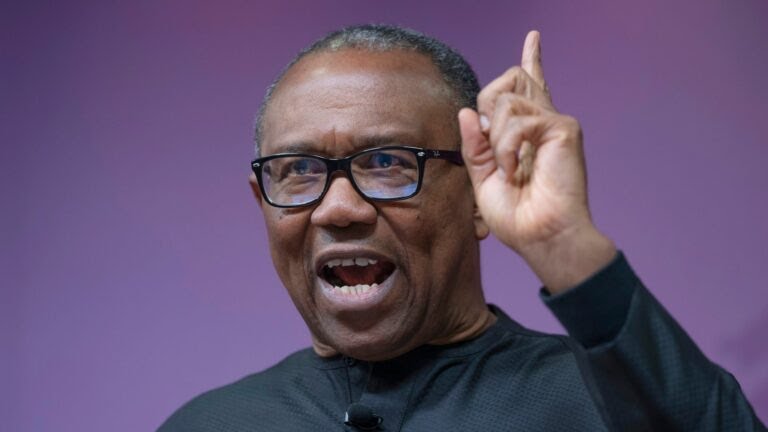
Photo: Mr Peter Obi
• Says he won’t run government by proxy, vows four-year tenure
• Rejects stepping down for Atiku, says opposition parties must negotiate
• Promises to fix existing roads before building new ones
• Says he’s ready to “die” defending votes with supporters
• Vows to lead fight against terrorism, visit conflict zones
By: Daniel Kanu
Presidential candidate of the Nigeria Democratic Congress (NDC), Mr Peter Obi, has declared that he would unite Nigerians if given the opportunity to lead the country from 2027.
He also noted that he will concede defeat in the 2027 presidential election if the contest is free, fair and credible.
Obi, who spoke in a pre-recorded interview with Arise Television anchored by Ojy Okpe on Thursday, also said he would not run government by proxy if elected, promising to take direct responsibility for his administration and remain accountable to Nigerians.
The former Anambra State governor addressed a wide range of sensitive political and national issues during the interview, including the 2027 opposition realignment, his relationship with former Vice-President Atiku Abubakar, electoral integrity, the 1966 coup, insecurity, petroleum subsidy, infrastructure and his proposed four-year presidency.
On the possibility of stepping down for Atiku, the NDC candidate said the issue had gone beyond individual political calculations, insisting that any arrangement for the 2027 election must be negotiated by the political parties involved.
He said he was currently the candidate of the NDC while Atiku was a candidate of another party, stressing that cooperation would therefore require the parties to sit down and agree on a common strategy.
“Do you know where we are now? Where we are now is that I’m a candidate, my leader Atiku is a candidate of another party, so you are talking about two parties coming together; it’s no longer me or him,” Obi said.
He likened the situation to two corporations seeking to merge, arguing that it was no longer a matter of two individuals deciding over a drink to work together.
According to him, “it’s no longer me saying I don’t want to be this or that; no, we have passed that stage.”
Obi also rejected suggestions that he had previously been offered an opportunity to become Atiku’s running mate and turned it down.
He said, “Who said so? Where? I wasn’t even in any party where that offer was on the table. I wasn’t even in a position where it was being offered and I refused.”
On the 2027 election, Obi said he would accept the outcome if Nigerians were allowed to freely choose their leaders.
“I will concede defeat in 2027 if the election is free, fair and credible,” he declared.
He, however, said his campaign would deploy technology to monitor the voting process and transmit results from polling units to a central Situation Room in real time.
“I won’t set up a parallel INEC but will make sure that in every polling unit we have a system that transmits results in real time to our Situation Room,” he said.
Reflecting on the 2023 presidential election, Obi said his camp had relied on assurances from the Independent National Electoral Commission that the electoral process would be properly conducted.
“What happened was that we believed INEC. We trusted them because they promised to do the right things but instead worked for our opponents,” he alleged.
‘I’m ready to die defending votes’
Asked about supporters who have vowed to defend their votes in 2027, Obi said he encouraged Nigerians to protect their mandate through lawful means and added that he was prepared to stand with them.
“I encourage them to defend their votes and I’m prepared to die with them if that becomes necessary,” he said.
‘I will not run government by proxy’
The NDC candidate also sought to distinguish his proposed presidency from what he described as indirect leadership.
“I will be in charge and I will not run government by proxy. I will be answerable to the people,” he declared.
He said his administration would be driven by competent and credible officials, with clear priorities and direct presidential oversight.
Asked what he would do on his first day in office, Obi said his priority would be to appoint competent people, issue decisive instructions and consult stakeholders on critical national challenges.
He also promised that he would not remain confined to Abuja while Nigerians faced crises across the country.
“I will not sit in Abuja but will be at the forefront, visiting areas of conflict and discussing with the people affected on the best ways to resolve the conflict,” he said.
Obi again defended his pledge to serve only one four-year term if elected president, saying he would not remain in office beyond the constitutionally permitted period.
“I will not spend one extra day. Four years is enough to engender change and I did it as Governor of Anambra State,” he said.
According to him, achieving meaningful transformation does not necessarily depend on spending many years in office, but on identifying the right priorities, appointing qualified people and working effectively as a team.
On infrastructure, Obi said his administration would prioritise rehabilitation and completion of existing roads before embarking on new projects.
“We will not build new roads until we fix the existing ones,” he said.
He also promised to spend his vacation in Nigeria, saying he would even be willing to visit conflict-affected areas.
“I will spend my vacation in Nigeria, even if it means going to conflict zones,” he said.
The former Anambra governor also addressed questions surrounding the 1966 coup and the killing of prominent Northern leaders.
He said Nigeria must acknowledge the mistakes of the past without allowing them to perpetually define the country.
“Mistakes were made. We should not continue to dwell on that. We must move on by showing love and unity,” he said.
Citing Rwanda as an example of a country that overcame a traumatic national experience, Obi said his administration would pursue a policy of national reconciliation and unity.
“My presidency will unite Nigeria because I believe in one Nigeria,” he declared.
Obi also spoke about his relationship with the North, promising to focus on economic opportunities rather than political rhetoric.
He said his administration would harness the region’s vast arable land and turn its large population of young people into productive agricultural workers.
“I will assure them that I’m committed to their future by tapping into the huge arable land that has remained uncultivated, and turn the teeming almajiris into productive life in the farms, making them feed the nation and provide for industries and exports,” he said.
On the controversial petroleum subsidy question, Obi said he would first tackle corruption in the petroleum supply chain before determining whether the subsidy regime actually exists in the form claimed by government.
“I will first remove the corruption in the supply chain to see if truly there is subsidy,” he said.
On insecurity, Obi promised a more proactive presidential approach, saying he would personally lead the fight against terrorism and criminality.
“I will be effectively in charge and my government will not be reactive,” he said.
He promised to deploy modern technology to locate criminal elements and flush them out of their hideouts.
“There’s modern technology that can be deployed to know where they are and to flush them out. I did it as Governor and Evans, the billionaire kidnapper, confirmed that they ran away on account of that,” Obi said.
He said his administration would commit security agencies to aggressively pursue criminals wherever they operate.
Concluding his vision for Nigeria, Obi said his objective was to build a country where government would be accountable, resources would be deployed productively and citizens would have renewed confidence in the nation.
“I want to build a new Nigeria that is POssible,” he said.